Tag Archives: golf graphic

Creepers! Ugh!

As a coach, one thing I can’t stand is seeing shots come up short. But it is the norm for most golfers on most shots—irons, pitches, chips and putts. It drives me batty! In this lesson we’ll deal with the putts that come up short. I call them Creepers.
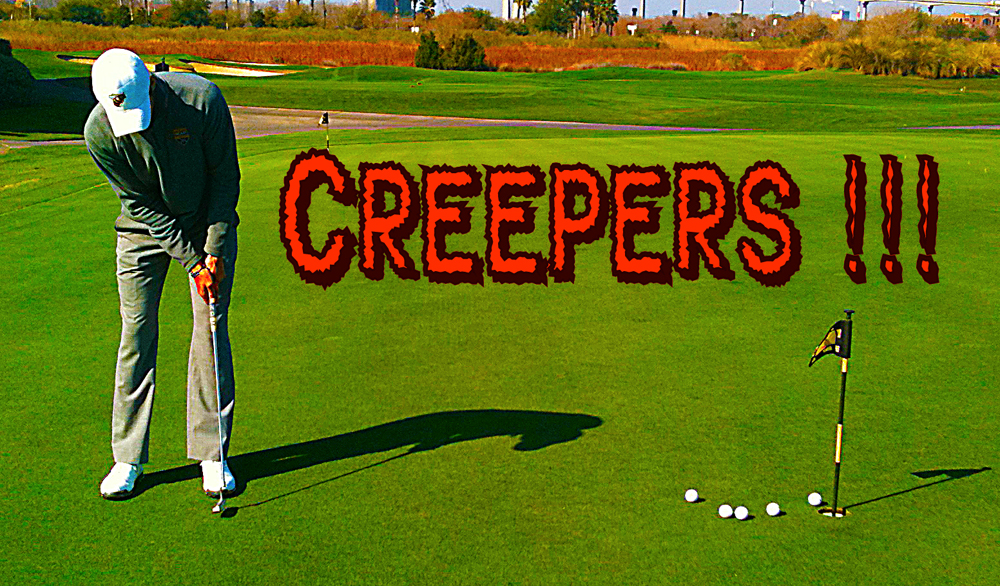
How many times have you played a round where hole after hole you hit putts that were right in the jaws but came up just short? I see it all the time. You had a chance to shoot your best score and you couldn’t get the ball to the hole! Frustrating, isn’t it? I know why it happens and I know how to fix it.

Next time you go to the course, watch the people warming up on the practice green. Most have either three balls or a single ball, and each person is putting to a specific hole. As each golfer putts, the ball rolls up short of the hole by about a foot or so. The golfer rolls putt after putt and the same thing happens. If a ball does drop it goes in by a dimple. If that doesn’t describe the scenario on your practice green, I’ll eat a bug.

I believe that the first 20 swings of the day with any club are the most important. Each time you warm up you are teaching your body what you want it to do each day. So, by coming up short time after time on the practice green, you are programming your eyes, brain and hands to come up short on the course. That’s why, when you come up short on putts hole after hole during a round, it seems no matter how hard you try, you keep coming up short.

Creepers! Ugh! I hate them! CREEPERS!!!

What I have my players do when they first get on the practice green is hit the first 10 putts or so well past the hole, by 3 to 5 feet. It may look silly, but it serves a great purpose. This practice drill will help you hole more putts for many reasons:

1. Your eyes see the ball getting to and going past the hole. You have to teach your eyes that this is a good thing. It’ll then tell the brain and hands that it’s o.k. It’s what you want to happen.

2. It helps ensure a nice long follow-through. If you tend to come up short, many times its because you stop your follow-through a little short. Mostly this happens because of fear of hitting a putt too hard. It’s interesting, isn’t it? A golfer can hit 9 putts out of ten short. Yet he fears the one that went long instead of the nine that came up short. Weird. Especially since the one that went by the hole was the only one that had a chance to go in!

3. You’ll make some of them! You’ll hear that awesome sound of the ball hitting the bottom of the cup. Even if your playing partners aren’t watching, they’ll hear it, too.

I believe that once your body gets used to hitting the ball past the hole, it is easy to throttle back a little. Then your pace on the green will be perfect all day. Conversely, it’s very tough once you’ve taught your self to come up short to make the adjustment to judge pace consistently. But one thing’s for sure: if you teach your ball to come up short during your warm-up, it’s gonna’ come up short all day long.

The lesson is this: “No Creepers!” My team hears me say this every day on the practice green. “Don’t teach yourself to come up short!”

Hit the first few putts of the day on the practice green well by past the hole. You’ll make more putts on the course.
The Golfer’s Achilles Heel

This is probably the first golf lesson you’ve ever had about your heel. You don’t hear many Pros talking about it. So lets talk about it.

When I am working with my golfers, the heel of the back foot is something I am always watching. I believe the heel’s finish position has a huge impact on where the ball is going to end up. I bet a week hasn’t gone by in all my years of coaching that I haven’t at least mentioned something about a players back heel.

For me, at the end of the swing, where the heel is pointing is the clearest and easiest indicator of whether a player has transferred his weight properly on the through-swing. Most amateur golfers finish their swing with their heel in a very poor position. I find this is especially true for older golfers.

“Who cares?” you say. “It can’t be that important!” Well… I do, and it is.

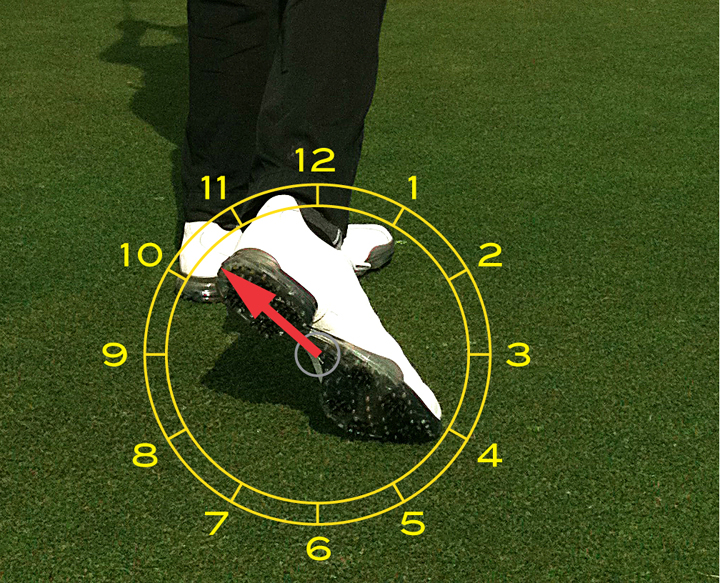
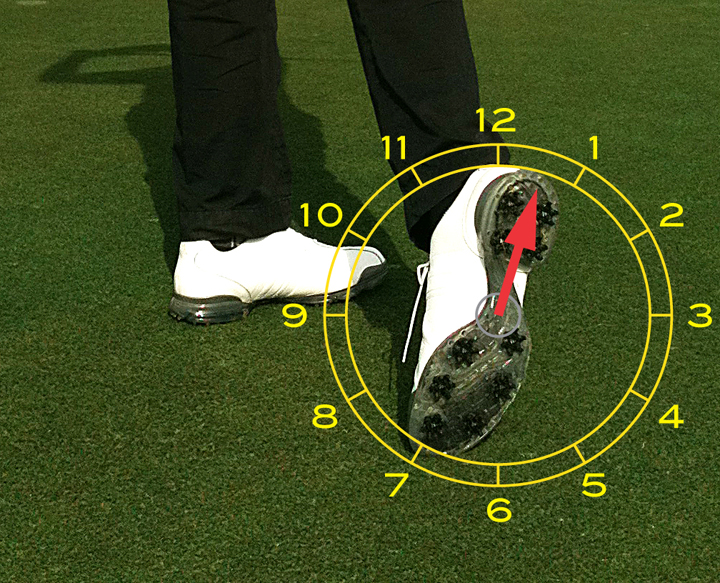
Let’s imagine a clock and the heel of the back foot is the hour hand. In this case we’ll use a right-handed golfer. If his heel finishes in a position earlier than 12 o’clock (shown in first photo) not only has his weight failed to transfer properly on the through-swing, but his hips never fully released, either. In addition, it is doubtful that he will ever be able to Cross the Finish Line. (Last lesson.)

Failure to get the weight off of the back foot causes the lower body to slow down.  To compensate for the lack of power from the legs, the arms take over, and then the hands get too involved. The result is usually an early release, which will produce thin shots, fat shots, a pull or a hook, a push, a slice, etc. Good luck with that.
This looks less than athletic; in fact, if you don’t get off back foot completely, you’ll look like you’re swinging a sledgehammer. When the heel doesn’t finish at 12 o’clock it’s very difficult to predict with any consistency where the ball is going. Especially when it really matters. I’m betting, not at the intended target. By the way, if this is you, you’re the guy I want to play for money.

If the heel ends up pointing at 12 o’clock or, preferably even later (shown in 2nd photo), the player has fully released his hips and will have a nice long balanced finish position; i.e., athletic. He Crosses the Finish Line. More than likely, the ball will end up in a great position. The by-product of getting the heel past 12 o’clock is that the clubhead releases at the proper time not only increasing accuracy but also swing speed.

Another huge benefit is physical. Failing to get your heel to 12 o’clock puts a great deal of stress, on your lower back. If your lower body slows down while the upper body continues to turn through at a high speed, this creates tremendous torque, which could cause serious back injury. Sorry Dad, this is one of the big reasons you’ve had back problems over the years. I’ve even had some of my college guys who look like perfect physical specimens struggle with lower back issues for this very reason. I once tried to swing with my back heel finishing close to the ground while continuing to turn my upper body through the shot fully and I thought I was going to break in half. Wow, was it painful! AND I hit an awful shot. Getting your weight completely off the back foot will eliminate much of the stress the golf swing puts on the lower back.

If for no other reason, get your heel past 12 o’clock to protect your back. You’ll save a ton on chiropractic visits and you’ll thank me for lower scores, too.

Verbal Use and Abuse

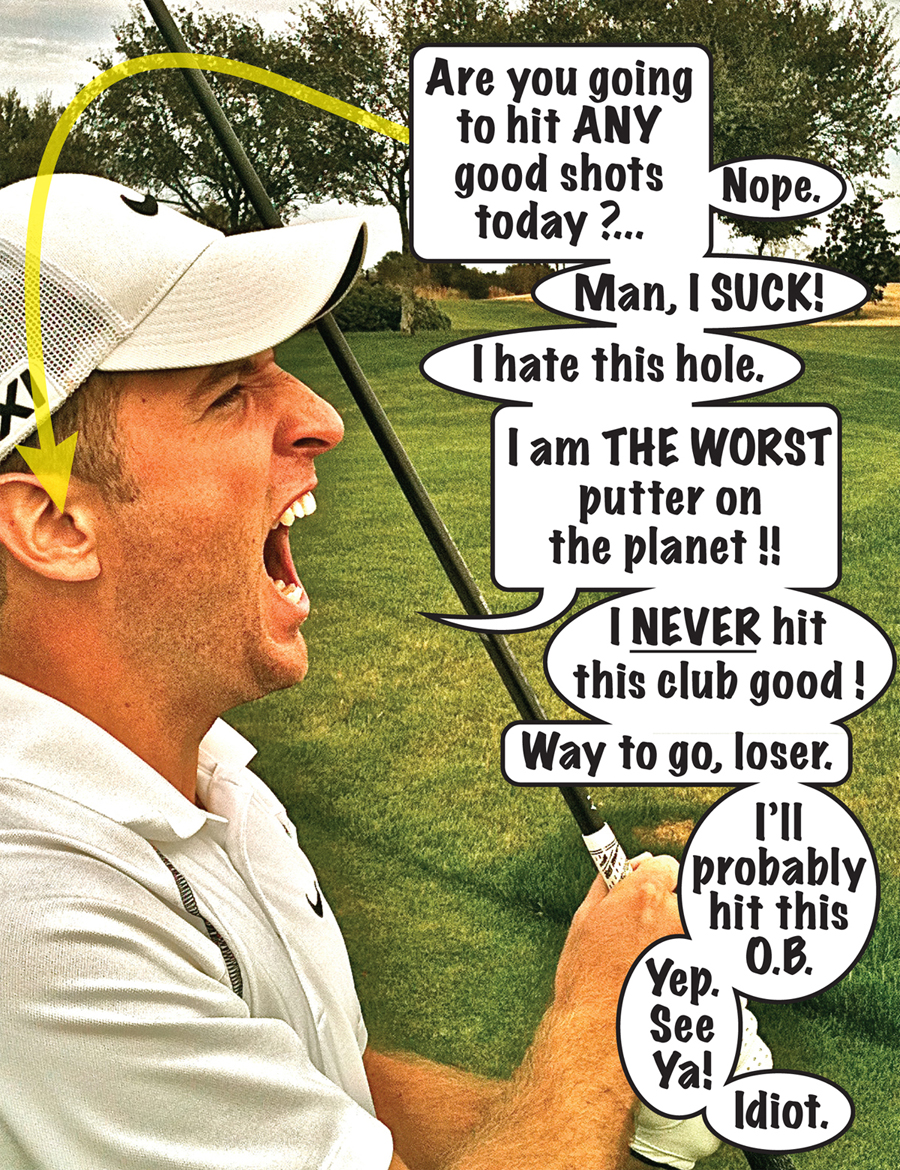
One thing most golfers are very good at is verbally acknowledging a bad shot. However, when they hit a good shot there is almost always silence. Why is it that most golfers are unable to compliment themselves? Why is this such a foreign idea? What ever happened to the adage, if you haven’t got something nice to say don’t say anything at all?

Look at it this way. If you had a caddie who spoke to you the way that you speak to yourself, you’d fire him. Period. But I see so many golfers who beat themselves up constantly. This destructive behavior makes it almost impossible for anything good to happen on the course.

I talk with my team about this subject a great deal. I tell them, “Remember, on the course, you are the only cheerleader you have.” So why is it that most golfers beat themselves up? Why aren’t they pumping themselves up instead?

Most golfers have two categories for golf shots. Either it is acceptable, in which case they remain mostly silent, or it is terrible, which is made obvious to all by negative self-talk. When they hit a bad shot, I would prefer that my golfers accept that they are human and therefore imperfect and prone to mistakes, and just let it go.  My rule is, if you insist in venting for the bad shots you must also say something positive when you hit a good shot. It’s only fair. Good and bad comments must balance themselves out.

On our team we have a rule: VERBALLY recognize every effective shot. By the way, verbal means, out loud. It is not acceptable to just think it. It has to be out loud. In fact, this is so important that over the years, during a few collegiate qualifiers instead of using scores to determine a winner, we have kept track of how many times a player has remembered to say something positive after good shots. That’s how serious I am about this. In time, my players notice that they’re actually doing far more good than bad just because they hear more positive comments than bad. This is a great way to improve a golfer’s self-confidence. And now, on the course we sound and play like winners.

Notice that the rule also says, verbally recognize every EFFECTIVE shot. An effective shot is not necessarily a great shot. Example: Let’s say you have a 7 iron into the green. You hit it thin and it runs most of the way on the ground, but finds the green. That’s an effective shot! It may not have looked pretty, but you met your goal. According to my rule, at this point, you have to say something positive. Why? BECAUSE YOU DID GOOD! Remember, the goal of a golf shot is not for it to look good, or to be technically perfect, it’s for the ball to find it’s target. Period. So don’t stand there in the fairway after a less than perfect shot rehearsing your swing and finding fault when you were just successful. Your shot found it’s target. You achieved your goal for Pete’s sake! Just pat yourself on the back and focus on the next shot; you’ll make a better swing next time.

For years, before focusing on positive self-talk, during a tournament round I would see many of my golfers hanging their heads and beating themselves up. And guess what? The more we assaulted ourselves verbally, the more we stunk it up. It would drive me nuts! Now that we employ the recognize every effective shot rule, my players have the ability to keep themselves in a positive frame of mind, even when things aren’t going their way. And guess what? Their bad play almost always turn around.

It doesn’t matter if you’re a college player, an amateur or a tour pro. If you let yourself get into a negative frame of mind, you might as well walk off the course, because nothing good is going to happen. I believe that whatever comes out of your mouth goes right back into your ear and then into your brain. It has been confirmed by scientists who study the brain that your thoughts actually carve out the grooves in your brain. That’s how a thought becomes a habit and a habit becomes behavior. This explains why most golfers never get better. They have programed themselves to expect the worst. It’s a fact, your brain is a computer and will only do what it’s programmed to do.

The solution is simple. Go ahead and react if you have to when you hit a bad shot. But then, when you do something good, pat yourself on the back. Tell yourself OUT LOUD that you did good. You must refill the emotional tank that negative thoughts and words use up. Learn to re-program your brain. Soon you’ll find yourself playing better golf and people will enjoy playing with you more.

We’ll keep talking about this subject in future lessons.

Thanks for following!

The Poop on the Loop

In the last lesson, The Pro Position, we we talked about where the clubhead needs to be when the shaft is parallel to the ground. In this lesson I’ll tell you why.

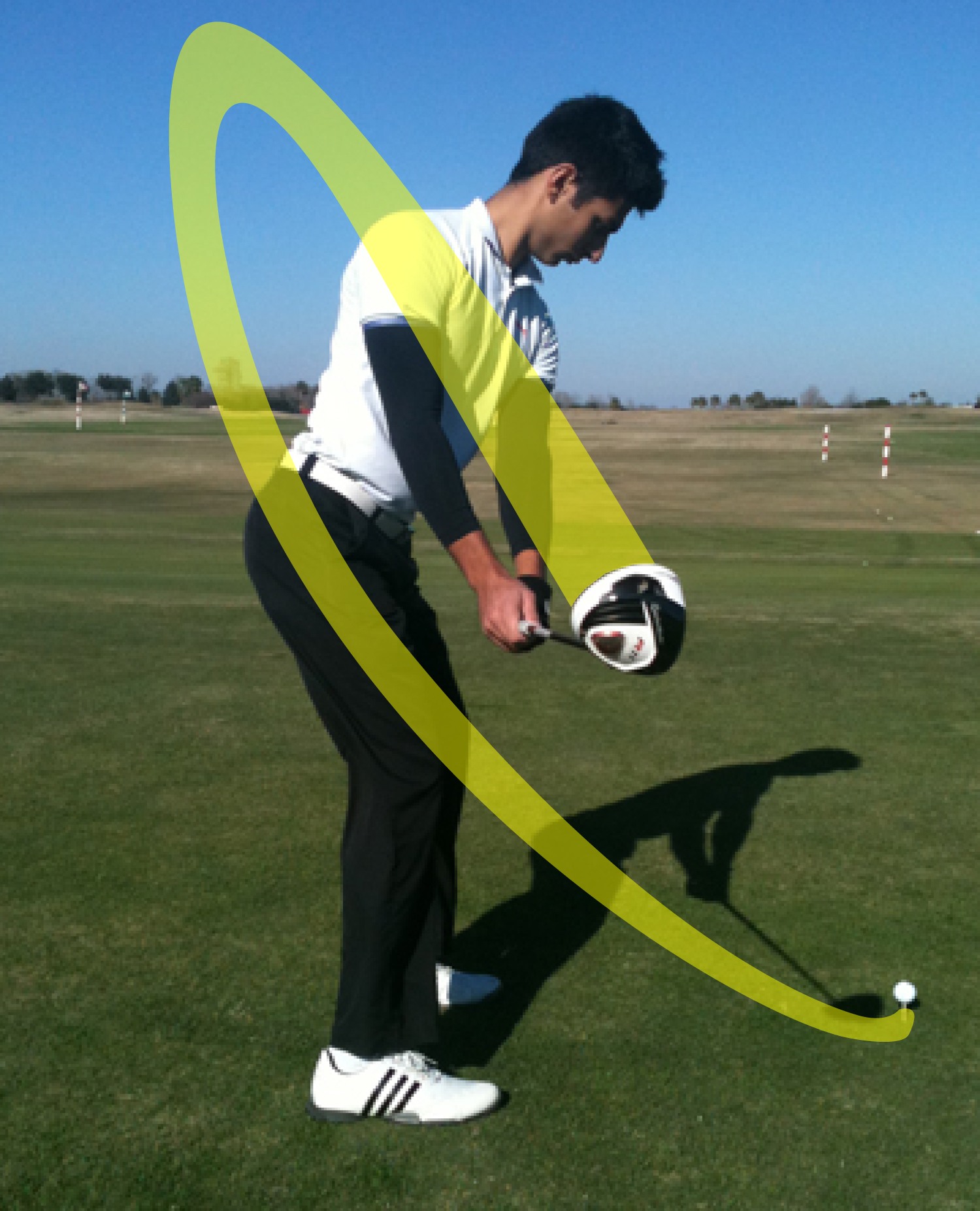
Here’s the poop. Like it or not, during the golf swing the clubhead is going to make a loop. The clubhead doesn’t just swing back and through on the same path. With all of the turning and twisting the body does during the swing this would be almost impossible and not to mention, counterproductive.

So, you have two choices. First, let’s talk about the best option. If you get into The Pro Position you have already done most of the work and the club is on a terrific path that will set the club in a beautiful position at the top of the swing. Then, without any effort on your part the club will come down into the ball on a nice inside path and you’ll hit the ball where you were aiming. By choosing this option you will play more confident golf and then begin to focus more on targets and playing more instinctively, instead of having doubts and fears running around your mind during the swing.

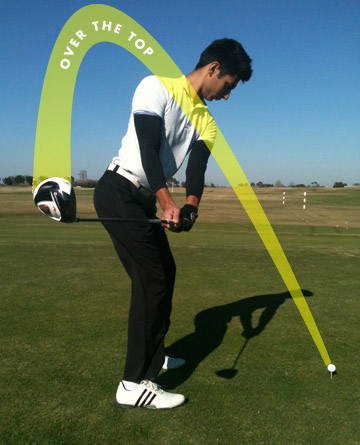
Now, the other option makes golf much harder. If you take the club back inside when the shaft is parallel to the ground your body will begin its process of trying to make compensations for a faulty swing path. Because the clubhead is stuck behind you at this point your arms will begin to lift the club to try and re-route the club. This more than likely will result in the club coming in from the outside or, the classic over the top move. Many golfers have this move but they don’t understand how they do it and more importantly, they don’t know the cure. Well, here it is.

When the club comes over the top it creates so many potential problems that I can’t discuss them all in one lesson. Each person who hits from over the top has their own unique way of screwing up the shot. Sometimes you’ll hit snap hooks. Sometimes you’ll hit pull-slices.Sometimes you’ll hit it straight. The possibilities are endless. And if your brain knows the possibilities are endless its going get overloaded. Now many golfers can play decent golf with an over the top swing but they’ll never play to their potential. Because in crucial moments the compensations the body and mind are trying to make, don’t usually work when you’re in a pressure situation during your round.

This loop keeps golf very unpredictable from day to day and shot to shot.

So that’s the poop on the loop. I say, make this hard game as easy as possible.

Thanks for a awesome first week! The response has been great! Thanks for the comments and as always, if you have an issue you’d like discussed, leave it in the comment box. I’ll get to them.

Recent Entries »