Tag Archives: golf

How to Make More Short Putts, Because a “Gimme” Isn’t a Real Thing.

three footers

Short putts terrify many golfers. This is one of the main reasons, “the gimme” as become so common. Most casual golfers aren’t required by their equally scared playing partners to hole out their short putts. By the way everyone, no where in the rules of golf is the concept of a “Gimme” ever mentioned. Yes, in a match play format you can concede a putt or hole, but how many of you are playing match play? This is a sore subject with me because I am a golf purest and the entire object of the game of golf is to get the ball in the hole! When I hear someone say, “pick it up, that’s good.” I have to bite my tongue. It drives me absolutely crazy! Getting the ball in the general area of the hole is not good enough! In the rules of golf it clearly states, “In stroke play the hole is complete once the ball has been holed.” That means the ball comes to rest in the bottom of the cup.

I hear all the reasons and excuses as to why people play, “gimmes”. Sorry, none of them are legit. “But it speeds up play.” “They would have made it anyway,”… blah, blah, blah. Sorry, it all amounts to one thing… you’re cheating.

This will give you a good explanation why you shoot far worse scores in tournaments than you do day in and day out. It’s because you don’t get any practice making short putts while playing under pressure. How different would your score be if you putted all the short ones? A good putters score wouldn’t change but a bad putters score would be very different.

Forgive me, I’m trying not to get to preachy, but the reward for all the hard work it took to get your ball so close to the hole is to hear the wonderful sound of the ball rattling around the bottom of the cup. Also, making the close ones are a demonstration of ones skill, nerve and focus. “How many times have you seen a major championship decided by a player making or missing a 3-foot putt? How about EVERY ONE!”

I get it though. Once confidence that you can make a short putt is gone, fear is the next emotion that dominates the mind. A mind full of doubt is obviously terrifying and most times ends in embarrassment. Because when standing over a short putt with little confidence, you know and your playing partners know you’re probably going to miss it, and sometimes you’ll miss the following putt also resulting in you raking up the ball with your putter and walking quickly off the green mumbling insults at yourself.

So, lets make more short putts. Try this easy drill:

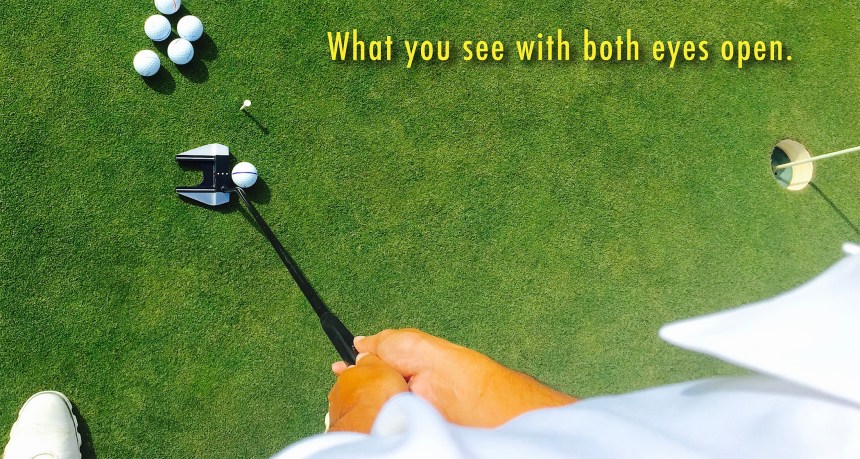
two eyes

Get a bunch of balls and put a tee in the ground about 3-4 feet away from the hole. This way you can practice the same putt over and over to develop muscle memory and confidence.

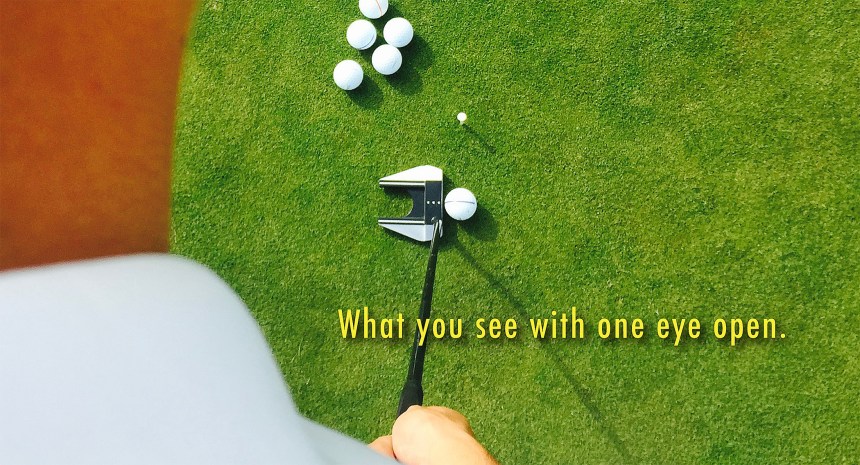
one eye

Once over the ball and you feel you are aligned properly, close your left eye (if you are a right-handed golfer) and keep it closed while you stroke the putt. The reason you do this and I believe a big reason some people miss short putts is that it takes away peripheral vision. I believe strongly that seeing the hole out of the corner of ones eye is the distraction that prevents golfers from being able to focus on making a quality stroke. I have found that if I take peripheral vision away, a golfer can completely focus on watching the putter come through the stroke on a quality path and focusing completely on seeing the putter contact the ball without ones attention wandering or trying to guide the ball to the hole. As Gary Player would say, “you should LISTEN for the ball to go in the cup.”

I believe that in golf you can’t be scared of something you can’t see. If you can’t see the hole it will free you up. I’ve introduced this drill to hundreds of golfers. Some even do it while they play. This drill will help golfers focus on putting a nice roll on the ball, learn to keep the hands moving through the stroke, keep the head steady, and more importantly, calm the mind.

So, NO MORE GIMMIES!” Putt them all!

_____________________________

3-d-book-cover

Fred Fruisen is the author and illustrator of punchline‘s new book, 50 Reasons to Hate Golf and Why You Should NEVER Stop Playing! Click here to order your copy today!

A Mini Golf National Open Championship…Seriously? YES! Seriously FUN!

IMG_9147

Recently I read that the first New Zealand Mini Golf Open Championship was going to be played right here in Auckland. I thought, No way! I have to be a part of this!

Sure, like all of you, at first I was thinking, Come on, this can’t be serious. But everything associated with the event seemed like a big-time tournament. There was qualifying to get into the event, and there were par 2s, 3s and par 4s on the course. There is a New Zealand Mini Golf Federation, and there are even professional mini golfers! I quickly learned that this is pretty serious stuff and that competitive mini-golf is massively popular in Europe.

I couldn’t help but think to myself, What kind of weirdo is going to play in this event? Then I answered my question: ME! That’s who!

Over the next weeks I qualified and practiced enthusiastically. I’ve never played mini golf seriously before. The winner of the event would even gain automatic entry into the World Mini Golf Championship in Croatia later in the year! All the while I was thinking, This is can’t be a real thing. But at the same time I was thinking This is going to be an absolute blast!

IMG_9132

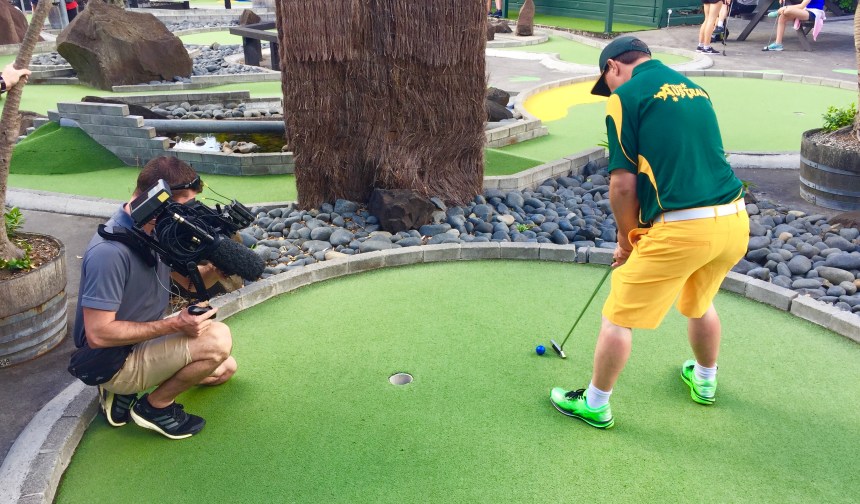
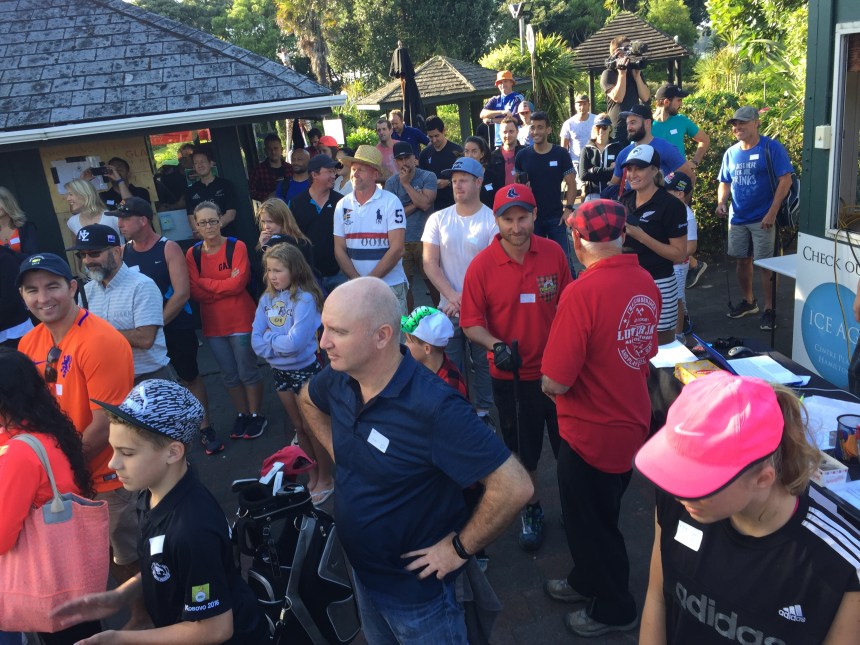
I showed up on the day of the event to find that around 85 golfers had registered to play in the first NZ Mini Golf Open Championship. There was even a professional mini golfer (Allan Cox) who came over from Australia to participate. He’s been a professional mini golfer for 25 years.

I was a little surprised when I showed up. I was expecting a nuttier vibe. It was just a really fun group of people. Fun, and serious! I made it a point to talk to the experienced mini golfers. I spoke to the New Zealand current women’s and men’s national champion, Lucy Geisen, and Bobby Hart. Both have participated in the World Mini Golf Championships. I had to ask them two questions: Why? and How did this happen?

IMG_9152

The answer was simple—competition—which was no different from the reason that I was participating. Bobby Hart is a soccer coach, and Lucy is an athlete who played many sports in her life, and both craved the same thing, an avenue in which to compete. AND mini golf is so much fun! Lucy and Bobby both also commented on the quality of people they have encountered through mini golf.

What I experienced as I teed off on the first hole with people watching and cameras pointed in my direction was the same first tee jitters I have felt during important golf tournaments. And over short putts, I felt the the same real nerves.

The format for the men’s division were as such: we’d play in foursomes in a 54-hole stroke-play event, played over 2 courses, with a cut after 36 holes. The ten lowest players would compete for the title in the final round. I was determined to make the cut. I didn’t think I could win, because I was immediately intimidated by the serious mini putt players. You could tell who they were by their equipment (special balls) and their outfits. Yeah, I felt like a rookie.

IMG_9131

The tournament was run very professionally, with Red Bull and others as sponsors. There was a scoreboard, and there were first class trophies and rules officials. You had to sign your card after the round, too… all aspects of a traditional golf tournament carried over to the Mini Golf Championship. We had fans, media coverage, cameras, and a lot of cheering. I’ve been to The Masters in Augusta many times. I’ve heard the roars from distant holes. You even had that. Yes, even the roars and groans. Many of the holes were completely surrounded with on-lookers craning to get a view of the action. When you made an important putt or a hole-in-one, there was applause. It was fun to tip the cap in acknowledgement of the spectators—who appreciated fist-pumps with even more enthusiasm. There was a lot of energy and excitement surrounding the event.

After a few holes I settled down and was playing well. At the end of the first round I was one under, and I believe only one off the lead. I had even beaten the professionals in my group.

IMG_9141

I started the second round slowly, missing some short putts. Hey, I admit it! I was nervous. I figured the professionals in my group would be very motivated to show their stuff in the 2nd round, and I was right. Both Alan (from Australia) and Bobby (the New Zealand Champion) came out on fire. They played well on the front nine, and I struggled. I pulled it together on the back nine and ended up even par for the round. Alan, the professional from Australia, came back strong after a disappointing first round and shot -4. Bobby played well the 2nd round, shooting under par after struggling in the first round.

We waited for about half an hour after the 2nd round while scores were being entered into the scoreboard, and we were all wondering if we’d make the cut. This time gave me a chance to get to know more about some of the hard-core mini golfers.

We were all a little nervous.

Then came the results… I was in! I made the cut! Mission accomplished. I was 4 shots out of the lead going into the last round and would need a strong showing on a tough and unforgiving course. Anyone within 5 shots of the lead had a chance. There were some tricky holes out there that could blow up your score. For example, there was a 3-tiered hole where in the first round I made a hole-in-one and the defending champ made a 5. So, anyone in the final 10 had a chance to win.

In the final round I got paired with a lad named James Turner. He is a professional rugby player from the Hamilton Chiefs. He and some of the other boys from the team who were on injured reserve came out to participate for a couple of reasons: 1) to have a laugh, and 2) to compete.

IMG_9178

Me and the lads from the Chiefs. James Tucker (brown jacket), big guy with a great stroke.

I struggled the last round in spite of hitting two holes-in-one. I was really disappointed! I thought I might able to win, but my nerves got to me. I missed some crucial second putts and also got some bad breaks, as you’ll tend to get in mini-golf, or any form of golf. I think I shot a 3 over par. I ended up finishing 6th, a respectable showing in my first mini putt major.

My 15 year old son also played in the youth division. He came 3rd, which was awesome.

Would I do it again? Absolutely! I already can’t wait till next year and have been contacted about joining the local professional mini putt tour.

This was some of the most fun I’ve had in a long time. I would recommend competing in the Mini Golf tournaments to everyone, golfers and non-golfers alike. I’m going to get as many friends as I can to come next year and give it a try. Anyone can do it, at any age! There are also divisions for youth, parent/child, and women.

Who doesn’t love mini-golf? Nobody. Not many other activities can lay that claim. We all have great memories of playing mini golf as a kid. Perhaps we should all do more of it, if for no other reason than to feel like a kid again.

SOOO much fun!! Give it a try if you can.

“The Commandments” – an Introduction

About six years into my career as a college golf coach, I noticed a trend: golfers tend to make the same mistakes in tournaments year after year. It got to the point that I could predict with great regularity the error a player was going to make before it happened—an error that would either wreck his hole or change the course of his round. Seeing these mistakes year after year became increasingly frustrating, especially when my own guys were making them. Most of the errors I noticed were not swing related; surprisingly, most were strategic, stemming from poor decision-making or from a lack of awareness on the course.

commandments stoneEventually, I had enough and began writing down my observations. Before long I had a list of the most common errors I saw golfers make in tournament play. Determined to teach my team to avoid making these common mistakes, I started sharing the list with them. I knew that if I could teach my team to recognize these “traps” that players from other teams were falling victim to, we would have a decided advantage when competing.

Thus, The Commandments were born. I have been teaching my team to play The Commandments for about a dozen years now. My players even carry a copy of The Commandments with them every round. We talk about them just about every day.

There are eleven Commandments on my list—eleven things I ask my players to do, or not do, every round. Again, none have to do with swing. Surprising, I know. My guys have learned that the fewer commandments they break during the round, the greater their chances of shooting a great score—even if they don’t hit the ball well. Because of these playing rules our teams have had a lot of success. Once my players buy into using them during play, The Commandments become the glue that helps our players and team achieve great things. The Commandments give my players rules and structure to guide their decision-making and to help them stay patient, which translates into fewer careless errors and a less stressful round.

Over the next few years I will introduce each of The Commandments to you. I know that if you follow them, they will make a big difference in your score. And the best part is you don’t need to get golf lessons.

The Littlest Shots Make the Biggest Difference

If you’re like most golfers, you spend most of your practice time on the range, and finish up with a few quick minutes on the practice green. I believe everyone should reverse that and spend the majority on your practice or warm up time on the practice greens and less time beating balls. If you look around your club you’ll notice that the best players hang out around the practice greens a lot. If you want to be one of the best players at your club I would suggest you do the same.

COG 11 Ball Drill

At least half of your shots during a round come from on or around the green. Most of the time it’s the quality of the Little Shots that determine the quality of your score. You could improve half of your game simply and quickly by improving your skills around the green—without going through swing changes or investing money in lessons or equipment!

Many years ago, my wife and I spent our honeymoon in Scotland, the birthplace of golf. We drove from town to town seeing the sites and enjoying the Scottish culture. Almost every evening, almost everywhere we went, we noticed townspeople of all ages practicing putting and chipping.

COG 11 Ball Drill

Practicing your short game is a great after-dinner activity. I find it very relaxing. Late afternoon and evening is the most beautiful time of day, and there usually aren’t many people around to distract you so you can get in some quality practice.

It beats sitting on the couch, or trying to squeeze in a quick nine and being frustrated by poor play. Try investing time instead of spending time.

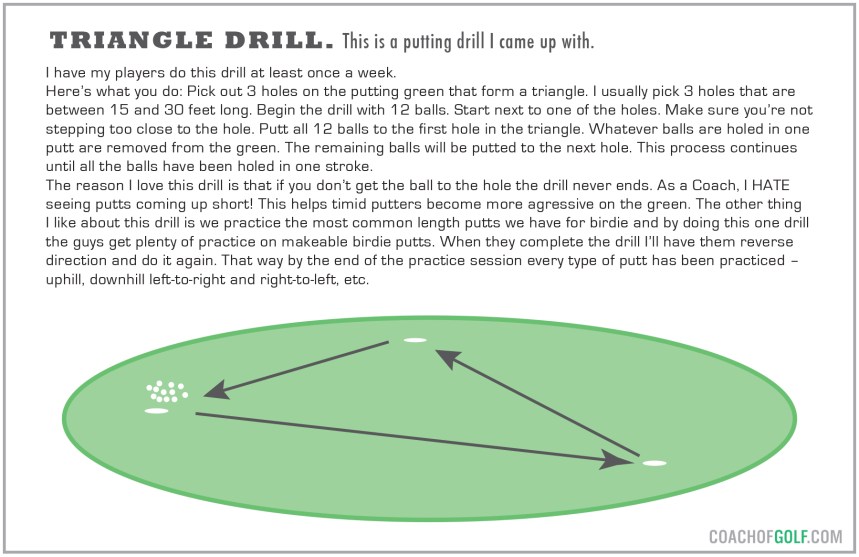
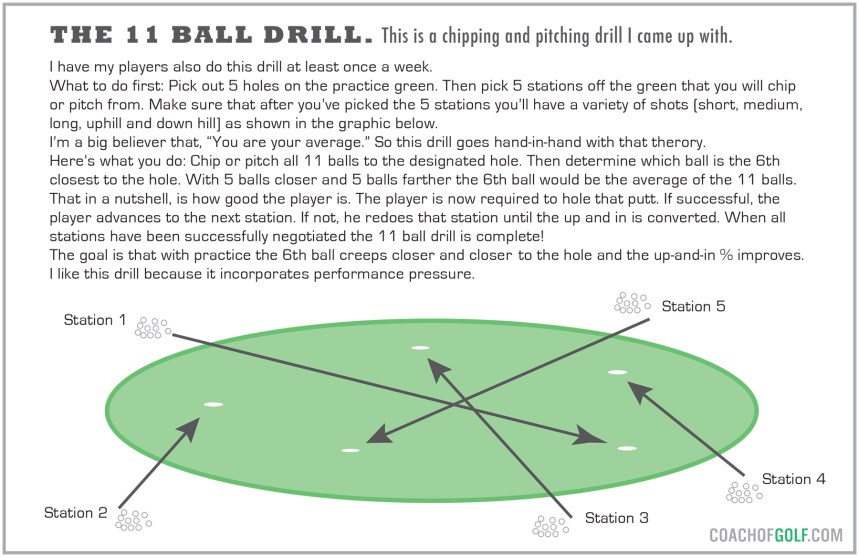
Here are two great drills that will help your short game. You only need a dozen balls and if you spend an hour or two a week doing these drills you’ll see real results.

I know these drills will help you score better and enjoy your rounds more.

It’s Always Darkest Before the Light.

Recently a player on my team experienced a major breakthrough. It’s a great story that could help many golfers, so I thought I’d share.

I have a player on my team named Brett. When I arrived at Skidmore College last year and assessed the players’ talent, I found Brett to be good from tee to green. He was a solid putter, but in two areas rated very poor:

1. Brett’s golf self-esteem was non-existent. He always believed the worst would happen on the golf course, and it usually did. Rarely did I see him get any amount of joy out of playing golf. Golf was a chore. He reminded me of Eeyore from Winnie the Pooh.

2. Brett’s short game, in a word, stunk. And that’s saying it nicely. He was dreadful when it came to pitching and chipping.

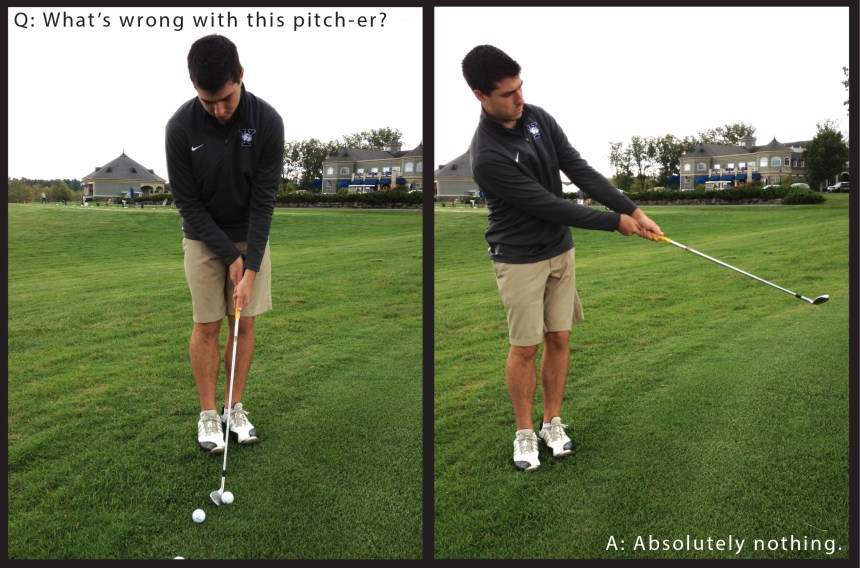
Whats wrong with this pitcher?So, we got to work. We spent a great deal of time over weeks and months working on mechanics and attitude, and we saw some progress. But even though he put in a lot of work, his confidence remained fragile. He had a deep seeded fear of chunking shots and thinning shots over the green, and if it ever actually happened, his confidence crumbled like a house of cards. We’d have to start all over again with fundamentals, drills and repairing confidence. This was the pattern all of last year and into the beginning of this fall season.

We had our first tournament a few weeks ago. Playing on the “B” team, Brett was playing well in the first round. I saw him at the turn and he told me he had hit every fairway and green; however, on the back nine, he began missing greens. His score went up quickly, and he shot a disappointing score. The next day was worse. The previous round eroded any hope of success. Needless to say, his score was really bad.

The next day at practice, Brett showed up with a “solution”: a left-handed wedge. Brett plays golf right-handed. It was clear he was a desperate man. He told me he was sick of going through this, and he was willing to try anything. I told him I respected him thinking outside the box, but I didn’t think that this was a viable solution. I suggested something that we had tried for about fifteen minutes last spring. He hadn’t been in a place mentally at that point to try something new, but now his mind was open. Here was the opportunity.

He tried it willingly. And within an hour his whole life seemingly changed. Within twenty-four hours, he was like an entirely different human being. I think that day was the first time I had ever seen Brett’s teeth at the golf course. Brett is quick with a smile off the course, but on the course you’d think his cat just died. I didn’t recognize this guy! He was having fun! There was hope! He called it, “a miracle!”

I watched him practice with amazement. Pitch shot after pitch shot floated beautifully through the air, landed softly on the green and cozied up close to the hole. Each shot was struck beautifully and effortlessly. Brett’s body language was completely different. He was relaxed and fluid–not the tense ball of doom that I had witnessed for over a year.

Over the course of the next week he challenged teammate after teammate to chipping and pitching contests (in the past he would have never done that), and won!

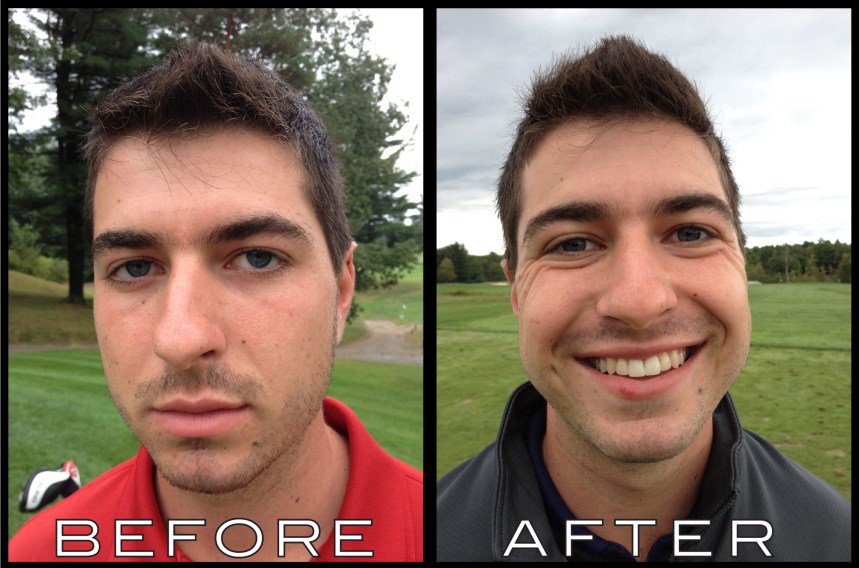
Before:afterOk, so what was the cure? Look at the photo closely. Did you catch it? I had Brett go left-hand low on his chips and pitches.

Why does this work? Because many times a right-handed player will carry all of his or her stress in the right hand. When that happens, the right hand squeezes the grips and stabs at the ball when under pressure and the left wrist breaks down. Reversing the hands neutralizes the right hand and allows the left hand to pull the club through the shot. Since the left side is the weak side for righties, you’ll be more prone to swing the club with the body, because you won’t be able to squeeze as much with the right hand.

I don’t recommend this for everyone. But hey, we exhausted all other options. In golf, there is no one right way to do things. The ultimate goal is be effective. I approach coaching the same way. Each player is a riddle and every riddle has a solution.

The other moral to the story is this: Desperation isn’t necessarily a bad thing. Until Brett was desperate, he wasn’t brave enough to embrace something new. When someone isn’t willing to try another approach, one thing is for sure – improvement is impossible.

I really respect Brett for his bravery. It’s nice to see him happy, confident and excited to play. This could turn his entire college career around.

The Dottie Pepper Interview

I recently had the honor of sitting down with the LPGA legend and NBC Sports golf commentator, Dottie Pepper.

UnknownThroughout her career she has been known as a intense, fiery competitor. Few athletes have a more fitting name.
Her passion has kept her at the the top of her profession(s) her entire life. Dottie had an impressive amateur career and in college Pepper was a 3 time All-America at Furman University. During her LPGA career, Dottie went on to win 17 times, including two major championships. Her nineteen under par performance at the 1999 Kraft Nabisco Championship is still a record. Dottie played on six Solheim Cup teams amassing a career record of 13-5-2, winning 70% of her matches.

Injuries ended Dottie’s playing career prematurely at age 38. In 2004 Dottie joined NBC Sports and went on to become one of the most respected on-course commentators ever to walk the fairways. In December of 2012, Dottie decided to retire from broadcasting to move on to new projects both personal and with the PGA of America. And, oh yea, she’s an assistant captain on this years Solheim Cup Team.

As we stood in her kitchen I asked her some questions about her childhood.

CoG: You were raised on a farm. What are some of the chores that you had to do?

Pepper : Our family had a turkey farm in Saratoga Springs, New York. Each year we had about 45,000 turkeys. One thing that most people don’t know is that turkeys are terrified of thunder storms. They freak out and they’ll all try and pile on top of each other. They’ll suffocate each other! So every time there was a thunder storm we would have to go out into the barns with brooms and chase around 45,000 turkeys and to try and keep them away from the corners, piling on and killing each other.

As we moved to her office we shifted the conversation to golf.

CoG: What did being an on-course commentator teach you about the playing and competing that you wish you knew while you on tour?

images-6Pepper : That it’s not rocket-science. It really isn’t.
I think as a player you over-think situations. Where when you take a half a step back, it becomes a lot clearer. Part of the reason why is that because when you are observing the game emotions aren’t so involved and so over driven. All of the sudden the light seems a lot cleared and the options seem a lot bigger and much more obvious. It’s just not as difficult as we think it is.

CoG: Name someone you have seen that we don’t yet know about who you think will be the next big thing on the PGA and the LPGA.

Pepper : On the PGA Tour, as an analyst you’re not suppose to be a fan, but I really am a fan of Bud Cauley. I really think this kid is going to be a rock star. There’s a mentality passed along from his dad who was a NAVY Seal. This kid goes out there—no excuses—and gets the job done. He’s one of only seven players to ever to earn his card through a few sponsors exemptions. That alone puts him in elevated territory. Mechanically his swing is great and he’s found a veteran caddie. Now he’s learning how difficult it is to play that many weeks. Because in college it’s a pretty scripted fall, pretty scripted spring, then in the summer you’re of on your own to figure out where you want to be to make sure you’re prepared for the next season. Well guess what? This IS the season. It’s all the time. I think that has been his biggest adjustment.

On the female side, I would look out for another Alabama product, Brooke Pancake. Terrific kid. Great story. Her dad passed away early so she’s been on her own and had to mature faster than most kids have had too. She was a top-notch student, plus a great player as well. She’s got the qualities to in her first few years to make a Solheim Cup. She’s that good.

CoG: For a high school golfer, male or female, what single piece of advice would you give them to be a successful collegiate golfer?

photoPepper : I would tell them to not just play golf. I would tell them to take advantage of the other sports, individual or team, and use them not only to keep their high-school experience complete, but for cross-training. It benefits golfers in so many ways. Golfers can get bogged down with the psychological aspects of the game, because it is slow. Where if you’re on the ski team, or football team or baseball, whatever, there is an instant reaction that ends up helping in golf. A break from golf is healthy. Myself and other professional golfers that came from up north did other things in the winter—we skied, bowled, played hockey, whatever. We played other sports in the winter and that probably helped our longevity.

CoG: Same question about college golfers wanting to go pro—what advice would you give?

Pepper : I would stay in college as long as possible. I really would. It’s not just about where your golf might be. It’s where you are as a whole person. In learning how to get around the country or how to interact with other people. Whether it’s your roommate, your teammates, whether it’s alumni, whatever it might be, I would take that time not only to enjoy the college golf experience but the college education and social experience as well. I see so many players who are in such a rush to get out on tour. I think that is a mistake.

CoG: If you could change anything about your playing career, would you?

Pepper : I’d be more sensitive about playing so many events. When I was at my best I played thirty-five weeks a year counting the LPGA and the “silly season” stuff. I developed some nagging injuries because of that, that later turned into chronic injuries that ultimately led to my playing career being cut short.

CoG: What is your craziest, favorite story you have about your playing career?

Pepper : It was in Japan at the end of the year. I made a 3 week trip over to play in a week of pro-ams and two events that we played that were on the LPGA schedule. We had what we called an “R. I. rule,” meaning “readily identifiable,” when it came to food in Japan. The last night of our trip me and two other girls went to this fabulous restaurant in Tokyo and we toasted the fact that we made it the entire three weeks without breaking the “R. I. rule.” As soon as we did, the shrimp in the basket sitting on the grill moved. They were alive! We all screamed! On cue they started jumping around in that basket. It was so gross!

CoG: Same question about your announcing career. What’s your craziest, favorite story?

Pepper : It was at the 2008 U.S Senior Open at the Broadmoor in Colorado. In the 2nd round during a couple of commercial breaks we hear rumblings that a bear is loose on the course. I ask the guys, “Where is he?” They say he is a couple of holes away, no big deal. Well don’t you know, about five minutes later we have just come back from a commercial break and I see this thing and he is going so fast coming across this hill, down underneath through a bunker and then up over a rise and then directly at me! (See photo.) He was so big and so fast and so gorgeous. The next week a guy from the USGA presented me with a bear that was made at a local shop. Roger Malbie’s comment to me was, “Kid, that was a bad day to wear white.”
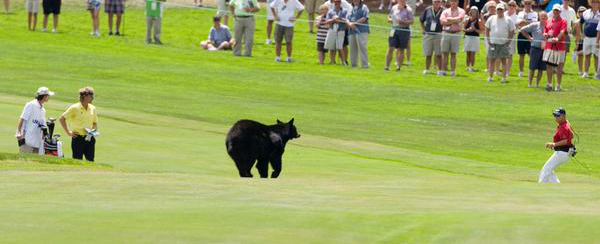
dottie and the bear

Coach of golf commentary: What I like most about this image is that Bernhard Langer (yellow shirt) is just standing casually observing with hands on hips as Dottie Pepper is about to be eaten by a bear!

CoG: Are there any rules in golf you would change if you could?

Pepper : I really don’t like the anchored putter ban, to be honest with you. I really don’t. And here’s why — (the argument) is being used as a “practice round” for (the future argument about) the golf ball—the ball that many believe goes too straight and too far. I think the they (USGA and the R&A) picked their easier fight to see what the reaction was going to be.  Knowing that there was a stretch that we are currently in where three of five major champions have won with a putter using the anchor-style method, so dramatically changed what was coming out of the USGA. In May of 2011 Mike Davis is on record, on video saying, “I’m not worried about it,” when there are no demonstrable numbers coming out saying that this method makes golf so much easier. Why, less than a year later, it is now so bad that the R&A is involved and looking at a ban? Just draw back the golf ball! They let that issue with the golf ball get so far ahead of them and so far gone, that I think they had to pick this fight to see how hard that fight would be. I think that’s essentially why I’m against it. I don’t like the way (the anchored putter) looks, but if it was that easy, if it made that big a difference, everyone would be doing it. It takes a different skill set to be able to operate that thing. It has to be fit properly, it takes a lot of practice to make it even work okay. I didn’t like the smell of it (this fight when it started), and I still don’t.

CoG: What is one thing that no one knows about Dottie Pepper that they should?

Pepper : Wow, hmmm…That I have a very green thumb. I love my gardens. I volunteer at the local florist. I work in the back room. I love it. That’s my thing that nobody knows. If I had to have a business to stay home all the time, that’s what it would be. It totally captivates me.

————————-

Dottie now lives in her home town of Saratoga Springs, New York with her husband, David and their dog J.P.

————————-

Bogey Tees OffWith  co-author Scott Fuller, Dottie wrote Bogey Tees Off (Volume 1, A Lesson About Being Truthful) in 2012. The children’s picture book, illustrated by Kenneth Templeton, is available at amazon.com in both hardcover and paperback. If you order the book through the New York State Golf Association website NYSGA.org $5 of each sale goes to the New York State Golf Foundation.

A Golfer’s Biggest Hazard

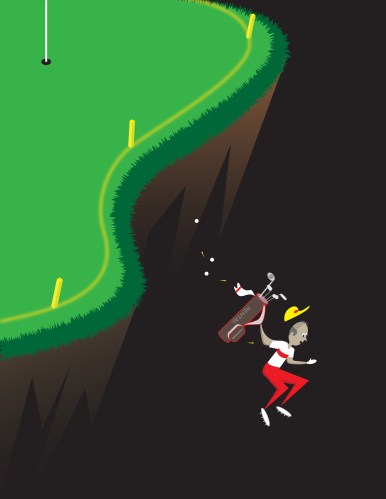
golfers biggest hazardThe biggest hazard that a golfer will face during their round is the temptation to mentally quit during a round of golf. For some reason, golfers go into a round of golf not expecting adversity. This is flawed thinking because it is inevitable. Because they are not mentally prepared, they are shocked and saddened when adversity arrives and too many times they are unable to cope. Like in the illustration, they willingly jump off into the abyss of despair, where there is no recovery and the penalty lasts for the remainder of the round.

Somehow golfers believe that every shot will be hit perfectly and that golf will be easy. That is not reality, not for any golfer at any level. Golfers must remember that golf is usually a struggle. Golf is the equivalent of salmon swimming upstream. It’s hard. It’s hard almost every day.

When you prepare for a round of golf, you should make a mental commitment — a commitment to accept whatever happens, good or bad, and in the words of Winston Churchill, “Stay calm and carry on.”

Staying calm and carrying on no matter what is the only good option you have. Some days are easy, most are hard. You must remain positive and fight with everything you have until you arrive at the clubhouse. Otherwise, you’ll be miserable, you’ll make your playing partners miserable and you will be guaranteed you will shoot a miserable score.

I know all of you have watched Tiger’s top 10 shots on the Golf Channel. Did you notice that none of those shots was from an ideal position? Only one of shot happened from the middle of the fairway, and he hit that shot in almost total darkness.

The point is, one of the reasons he’s been so successful is that he believes with every fiber of his being that something good will happen even when he is in a tough spot.

I have a great example from my university team in 2012. One of the freshman on my team was named Makenzie. He was a fine player and I believed he could become a superstar, but as with most freshman, he had a lot to learn — especially when it came to keeping his head in the game during tough rounds.

We were playing in a prestigious tournament. The Golfweek Fall Preview in Florida. This is an account of Makenzie’s final round.

He had high expectations, too high. When I saw him on the range, Makenzie was upbeat, “minting it” as he says, and was telling me he was going to tear it up.

So, I caught up with him on the 7th hole, a par 5. I thought he has just played his 2nd from the fairway, but I then learned that it was actually his 4th shot. His 2nd shot had gone out of bounds. He was completely despondent because after finishing his 7th hole with a double, I learned he was now seven over after seven holes. The round was not going at all the way he had envisioned. I could tell he had mentally checked out and he had no fight in him. If I had given him the option he would have walked off the course. I told him, “Sorry dude, I don’t get to substitute like in other sports. You’re stuck out here and have to make a decision to make. Are you gonna cry or try?” It’s something I used to say to my young son. He would always take on projects that were beyond his abilities and eventually get frustrated to the point of tears. I would say to him, “Son, we can cry or try, we can’t do both. We’ll do which ever one you want. But you have a decision to make.” Back to Makenzie… he was mentally checked out and we still had 11 holes to play in the final round of a really important tournament. I wasn’t going to let him let his team down or himself down. I told him, “We can still salvage this round! So, lets get started right now!”

makenzie action wedge

On the par 3, 8th tee he hit last so we had time to chat. I got his mind away from his troubles and told him how much I thought of him as a person and as a golfer. I reminded him how beautiful this part of Florida was and how blessed he was to be able to play college golf.He hit a nice approach. As we walked to the green we laughed as I told him stories of other golfers I coached through the years and the times when they were able to make something out of nothing. When we got to the green we were surprised to see he was left with a really difficult 36 footer that was down hill and a double breaker. We read the putt from every angle and what do you know, we made it for birdie! Big smile on his face! He was back!

On the most difficult hole on the course, the par 4 ninth, he played the hole well but ended up 3 putting from long range for bogie. Just like that, his world was coming to an end once again. I said, “What is so bad? You’ve just played the last 2 holes at even par after a terrible start on the first 7 holes! So I continued to make him smile, telling him funny stories about coaching and golf as we played the par 4, 10th hole and what do you know, we made a really good 18 footer that broke from left to right for another birdie!

Once again, big smiles, life was good. Unfortunately, he bogeyed the par 5, 11th and was once again in the dumps. Total despair. Life sucks! He thought, golf hates me! After more cheerleading from me, he made a routine par on the par 3, twelfth. I pointed out to him that in spite of the ups and downs that he had just played the last 5 holes at even par and that he’s doing fine. But now I had to leave him to go check on other members of the team. I had him promise me that he would remain optimistic and upbeat. He assured me he would be fine.

I caught up with Makenzie again as he was walking from the 13th green to the 14th tee. His life was over! He had just triple bogeyed! All of the fight was completely gone. There was nothing left. He was now 10 over par.

At this point, I’ll admit, I had had enough! I “coached him up,” as we say in the biz, albeit firmly. I told him he had a decision to make — this time, it wasn’t as much about this round, but more about what kind of player he was going to be. I challenged him, “You’ve got to decide right now, is golf tougher than you, or are you tougher than golf?”

I had his attention. Once again, I told him that if he had total 100% belief that something good was going to come out of this, it would, and conversely, if he didn’t, it wouldn’t. Whatever he decided would happen, would actually happen. He was now completely on board. We then took a moment to map out the final stretch of 5 holes. I thought we could birdie 3 of the last 5. He completely bought in, had total belief in his skills and Makenzie went on to birdie 14, 15 and 16! He had completely erased the triple! Now he completely refused to let his mind have a single negative thought. We were on the 17th, probably the best chance for birdie and after a monster drive, ended up making a tough par after pretty much chopping up the hole.

He played the par 4, 18th perfectly and made a 10 footer for birdie to finish out his roller coaster round. We hugged and laughed. He had birdied 4 of his last 5 holes and 6 of his last 11. Makenzie played the last 11 holes at -1.  He shot +6 for the round and ended up helping our team.

Ironically, not once did we talk about swing during his round.

It wasn’t the most impressive round ever shot — a 77. But for him it was the springboard that propelled him to be a great collegiate golfer. As we stood there watching the others in his group putt out, I’ll never forget he had his arm over my shoulder thanking me for my help and telling me how much he had learned.

His collegiate playing career is now over. I can assure you, that’s one of the few rounds he remembers. That’s how it is in college golf. You play a lot of rounds in a lot of places. You don’t remember much about the good days. There isn’t much to remember. Those days are easy. The proudest and most memorable rounds are the ones where you dig deep when faced with adversity and come out on the other side learning something about yourself. The ones where you made something out of nothing.

If you never give in and jump off into the pit of despair, you too will have great stories to tell.

Verbal Use and Abuse

One thing most golfers are very good at is verbally acknowledging a bad shot. However, when they hit a good shot there is almost always silence. Why is it that most golfers are unable to compliment themselves? Why is this such a foreign idea? What ever happened to the adage, if you haven’t got something nice to say don’t say anything at all?

Look at it this way. If you had a caddie who spoke to you the way that you speak to yourself, you’d fire him. Period. But I see so many golfers who beat themselves up constantly. This destructive behavior makes it almost impossible for anything good to happen on the course.

I talk with my team about this subject a great deal. I tell them, “Remember, on the course, you are the only cheerleader you have.” So why is it that most golfers beat themselves up? Why aren’t they pumping themselves up instead?

Most golfers have two categories for golf shots. Either it is acceptable, in which case they remain mostly silent, or it is terrible, which is made obvious to all by negative self-talk. When they hit a bad shot, I would prefer that my golfers accept that they are human and therefore imperfect and prone to mistakes, and just let it go.  My rule is, if you insist in venting for the bad shots you must also say something positive when you hit a good shot. It’s only fair. Good and bad comments must balance themselves out.

On our team we have a rule: VERBALLY recognize every effective shot. By the way, verbal means, out loud. It is not acceptable to just think it. It has to be out loud. In fact, this is so important that over the years, during a few collegiate qualifiers instead of using scores to determine a winner, we have kept track of how many times a player has remembered to say something positive after good shots. That’s how serious I am about this. In time, my players notice that they’re actually doing far more good than bad just because they hear more positive comments than bad. This is a great way to improve a golfer’s self-confidence. And now, on the course we sound and play like winners.

Notice that the rule also says, verbally recognize every EFFECTIVE shot. An effective shot is not necessarily a great shot. Example: Let’s say you have a 7 iron into the green. You hit it thin and it runs most of the way on the ground, but finds the green. That’s an effective shot! It may not have looked pretty, but you met your goal. According to my rule, at this point, you have to say something positive. Why? BECAUSE YOU DID GOOD! Remember, the goal of a golf shot is not for it to look good, or to be technically perfect, it’s for the ball to find it’s target. Period. So don’t stand there in the fairway after a less than perfect shot rehearsing your swing and finding fault when you were just successful. Your shot found it’s target. You achieved your goal for Pete’s sake! Just pat yourself on the back and focus on the next shot; you’ll make a better swing next time.

For years, before focusing on positive self-talk, during a tournament round I would see many of my golfers hanging their heads and beating themselves up. And guess what? The more we assaulted ourselves verbally, the more we stunk it up. It would drive me nuts! Now that we employ the recognize every effective shot rule, my players have the ability to keep themselves in a positive frame of mind, even when things aren’t going their way. And guess what? Their bad play almost always turn around.

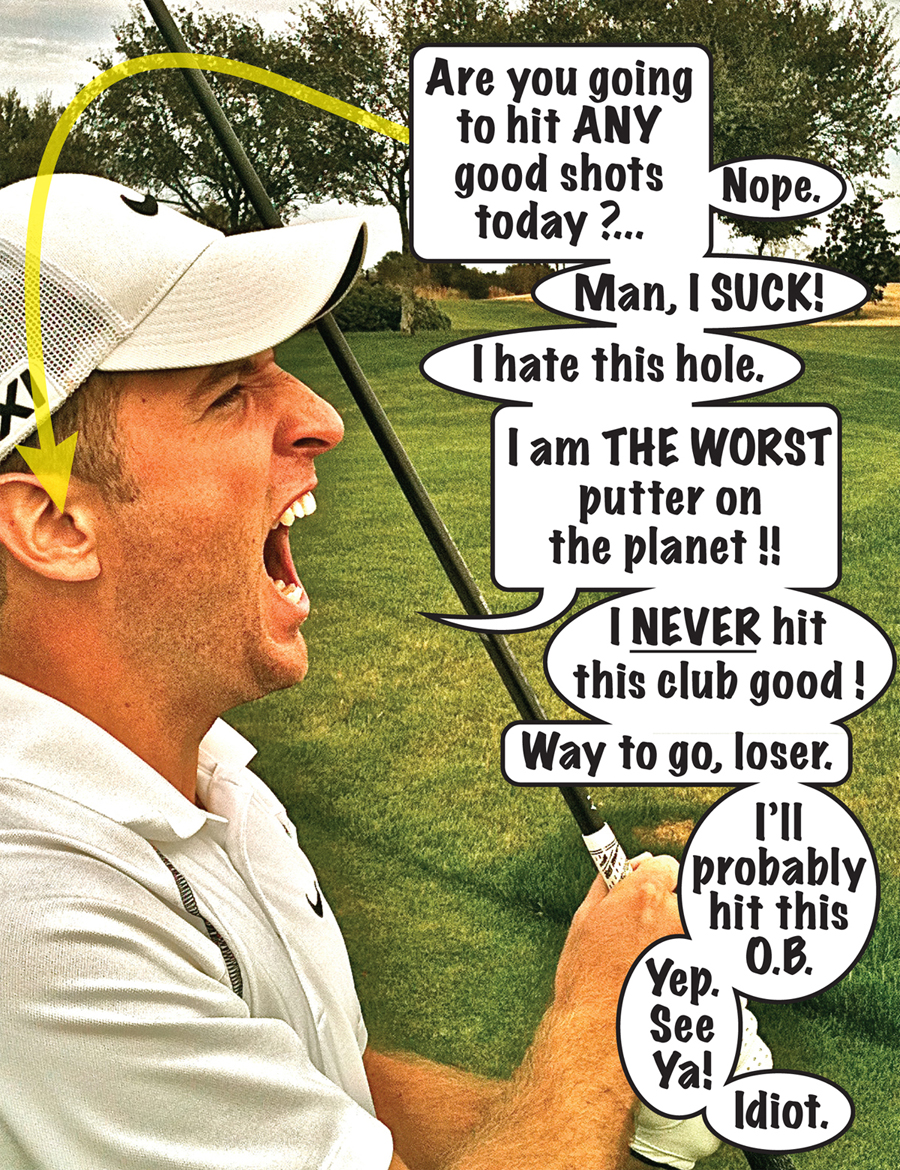
It doesn’t matter if you’re a college player, an amateur or a tour pro. If you let yourself get into a negative frame of mind, you might as well walk off the course, because nothing good is going to happen. I believe that whatever comes out of your mouth goes right back into your ear and then into your brain. It has been confirmed by scientists who study the brain that your thoughts actually carve out the grooves in your brain. That’s how a thought becomes a habit and a habit becomes behavior. This explains why most golfers never get better. They have programed themselves to expect the worst. It’s a fact, your brain is a computer and will only do what it’s programmed to do.

The solution is simple. Go ahead and react if you have to when you hit a bad shot. But then, when you do something good, pat yourself on the back. Tell yourself OUT LOUD that you did good. You must refill the emotional tank that negative thoughts and words use up. Learn to re-program your brain. Soon you’ll find yourself playing better golf and people will enjoy playing with you more.

We’ll keep talking about this subject in future lessons.

Thanks for following!

Friggin’ Brain

One of the ironies of golf is that you have to really use your brain, but it can also can kill your game. Learning how and when to use it is the key to good golf. The brain and the body should have a dialogue. However, if your brain is speaking when the body should be swinging, you’re gonna’ play bad golf. After their best rounds, all golfers say the same thing: “I wasn’t thinking about anything. I just let is happen.” Turning off the brain at the right time is crucial.

Standing over the ball at address for more than a few seconds rarely produces good results. If you linger over the ball on any golf shot, all your brain is doing is creating doubt and fear. I know, I know. You’re going through a check-list of all the things that you need to remember before you swing. While running through your mental list of to-do’s may seem like a positive, this practice is actually sabotaging your game.

Concentrating harder does not equate to better results. The opposite is actually true. If you let yourself be an athlete over the ball and turn your brain off during the swing you will have better results. You’ll swing more freely and you’ll have a lot more fun.

Scientists have determined that the brain can only think about one thing at a time. The key is to distract the brain from from thinking about golf while in the address position. In fact, Golfpsych, one of the top mental training programs employed by tour pros, recommends that many of their golfers think about anything other than golf between shots. Sometimes even while over shots.

Vision 54, another golf mental training program, teaches golfers to cross what they call the “commitment line.” You can think about technical things while you are behind the ball, but once you are over the ball you must rely on your athletic skill and intution. If while over the ball you start having technical thoughts you must then step away from the ball, clear your mind and start your pre-shot routine again.

What we need is a little self-hypnosis. When you drive your car to work you don’t think about what you’re doing or how it happens very often because we’ve done it thousands of times. Poof, you magically arrive without much conscious effort. You just let it happen. Your mind was elsewhere. You were on auto-pilot.

I like to have my golfers swing the club as soon as possible after they address the ball, not allowing time for the brain to do bad things. Brandt Snedecker does this. He commits, steps in and hits it. I work with many of my students to  determine the ideal amount of time it takes for them to get comfortable and then swing. On the range, I count out loud to train them on their timing. At first, most of them feel rushed, and you may, too. This makes sense, because almost everyone takes too long over the ball. As a coach I work together with my players to shorten their time.

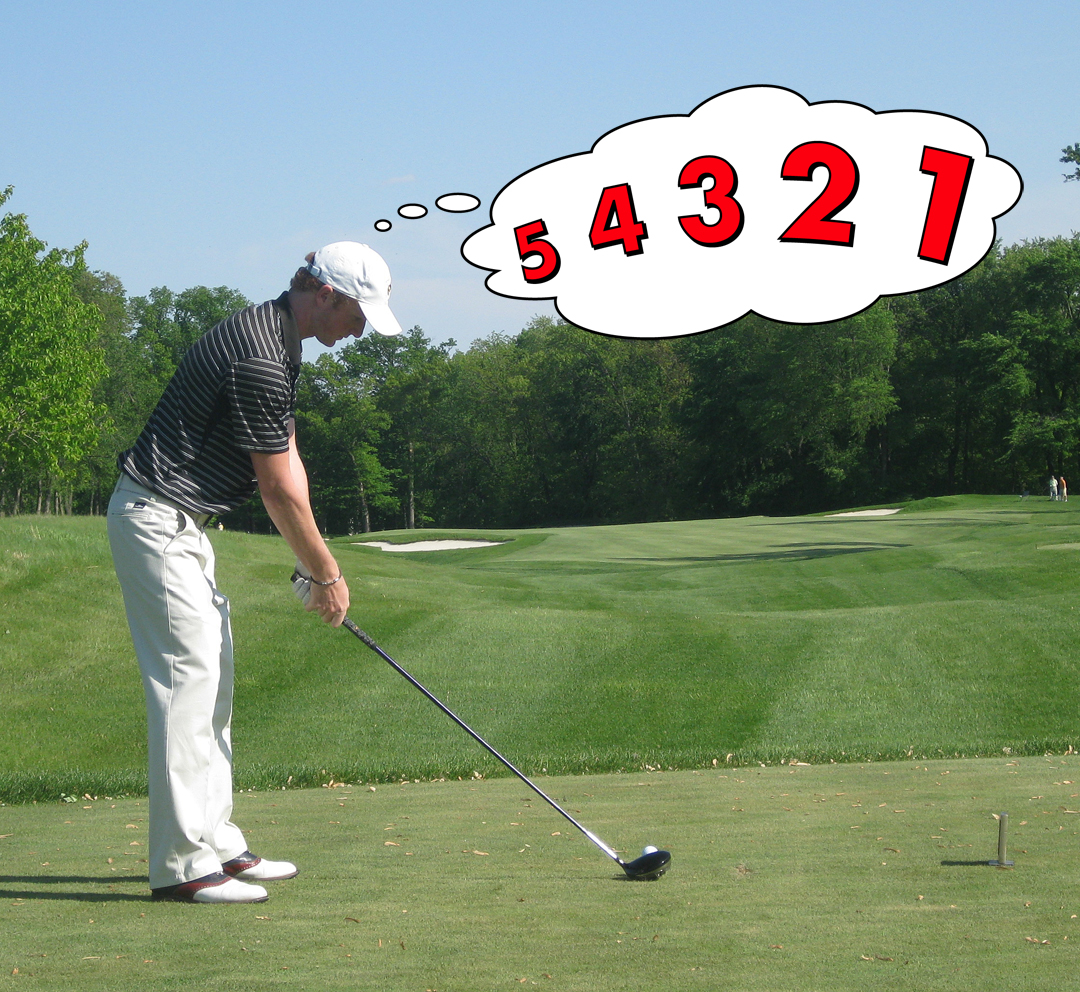
While I count the player will settle into the shot. He sets his feet; sometimes there is a waggle of the club or a tug on the shirt. Each golfer has his own unique way of addressing the ball. I will count slowly, “5… 4… 3… 2… 1.” When I say, “one,” it is time to pull the trigger. Ready or not. Boom! Players are always amazed at how much more frequently they hit the ball great, once they employ the countdown. They quickly realize all of the prep work they used to do was no help at all. If fact, it hurt them! This is a very liberating discovery. Greatness was there all the time, hiding behind that friggtin’ brain.

The countdown is a great pre-shot routine to adopt because if your brain is busy counting, you are not thinking about your swing, or O.B., or hazards, or score. Thinking about that stuff keeps you from playing your best. The countdown helps get you into auto-pilot mode.

Get over the ball. Tell your brain to shut up. And swing! Make sure you yell, “Boom!” while the ball is screaming through the air.

Each month I will be doing another piece about the Friggin’ Brain.

Thanks for following. If you find this helps you please come back I’d love to hear your comments!

Identifying Flying Objects

Unless you gain an understanding of what your ball is doing in the air you can’t take action to correct your problem.

There are only 9 flights that your ball will take after it has been hit. Once you have identified your predominant ball flight making the necessary corrections to your grip and alignment really aren’t that difficult. Hopefully this will help you better understand cause and effect and what adjustments need to be made to improve. Then, it’s a matter of staying committed to what is scientifically correct.

Let’s run briefly through each outcome. We will start in the middle:

Straight: This is the ideal. The club comes into the ball on a great path with the clubface square to the target. Life is good.

Hook: The path is good but the clubface is closed at impact. You just need to weaken your grip.

Slice: The path is good but the clubface is open at impact. You just need to strengthen your grip.

On the left branch of the ball flight tree (Pull) are the ball flights that of course start the ball left. Which means the clubhead came into the ball on an outside to in path.

Pull: If your ball goes straight left with no real curve the clubhead traveled on an outside to in path with a square clubface. You need to work on alignment which will affect the path of your club.

Pull Slice: The clubhead came into the ball with an outside to in path with and open clubface. You can play golf with this ball flight but you’ll really lose distance. But at least the ball works back toward the intended target.

Pull Hook: The clubhead came into the ball with an outside to in path with a closed face. If you hit this shot often keep a lot of balls in your bag, you’re gonna’ need them. Change your grip and alignment.

On the right branch of the ball flight tree (Push) are the ball flights that of course start the ball to the right. Which means the clubhead came into the ball on an inside to out path.

Push: The clubhead came into the ball with a inside to out path with a square clubface. Work on your alignment. You are probably aimed right.

Push Hook: The clubhead came into the ball with an inside to out path with a closed clubface. You can play golf with this ball flight because the ball works back toward center but you’ll probably have a pretty low ball flight and the top spin that this shot creates makes it difficult to control your iron shots because the first bounce on the green will be big. I recommend playing with a ball that gives you a lot of control. You have learned to have a strong grip to compensate for aiming so far right.

Push Slice: The clubhead came into the ball with an inside out path and an open clubface. Just like with the pull-hook if you hit this shot regularly keep a lot of balls in your bag. You need to work on alignment and strengthen your grip.

As you can see from the descriptions of each shot there are patterns. You’ll either want to adjust your grip or your alignment or both. Most of the root problems of the golf swing come back to a faulty grip and/or alignment. If you are willing to do a little investigative work and make some changes you can make a real difference in your game that will last.

In future lessons I will be giving advice on proper grip and alignment. So please keep following.

Thanks for the comments.

« Older Entries Recent Entries »