
How to Actually Play Golf
This is the first of a multi-part series on how to negotiate the golf course to achieve lower scores without having to think about swing or technique.
Over the years I have had countless golfers come to me seeking to answer a great big question: I’m great on the range, so why don’t I shoot lower scores?
Many times the reason is not swing-related, its a course management issue. The lessons in this series are designed to give you quick guidelines as to what to do, and more importantly what not to do, in common situations on the golf course.
Lesson 1
Understanding Green Complexes
Understanding what is going on around the green is essential if you want to score your best. Truth is, most golfers don’t hit the ball as far as they’d like to believe. Golfers tend to choose a club based on their absolute best strike, not their usual strike.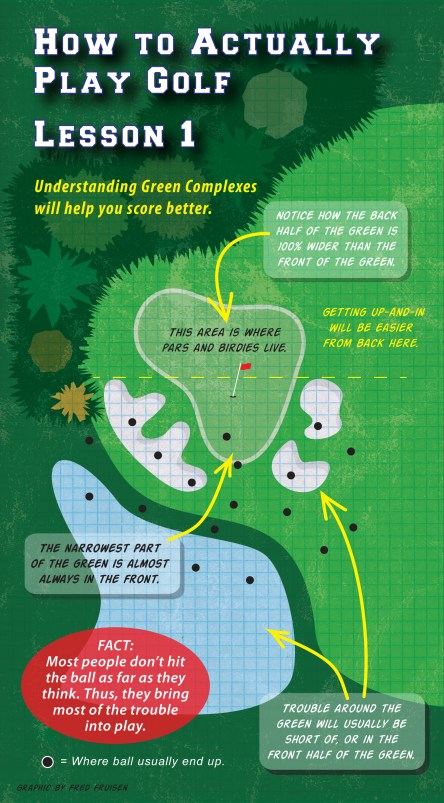 Also, I find that most golfers have an innate fear of hitting the ball long, which rarely happens. Combine these factors with how golf course architects design most holes and you’ve got a recipe for higher scores.
Study the green complex before you hit your shot, then follow the simple tips illustrated in this graphic and you’ll see your scores drop dramatically.
Bonus Hint: Hit one more club! You’ll make more pars and birdies, guaranteed. Also, the extra length allows for you to be the imperfect golfer you are. A miss-hit won’t be so penal.
Sure there are times when it is best to end up short of the green. If that is your intent, great! But most times, coming up short is born out of poor planning or not accepting the fact that you don’t hit a 7 iron as far as Dustin Johnson. Or even Zach Johnson, for that matter.
When I was a university coach I used to always say to my team, “During a round of golf one of two things are happening. Either the course is putting pressure on you to give up a score, or you’re putting pressure on it to give up a score.”
The latter is much more fun.
This article will also appear in the September 2017 issue of New Zealand Golf Magazine.
 Fred Fruisen, Timaru, New Zealand Golf Coach