Tag Archives: golf tip

Verbal Use and Abuse

One thing most golfers are very good at is verbally acknowledging a bad shot. However, when they hit a good shot there is almost always silence. Why is it that most golfers are unable to compliment themselves? Why is this such a foreign idea? What ever happened to the adage, if you haven’t got something nice to say don’t say anything at all?
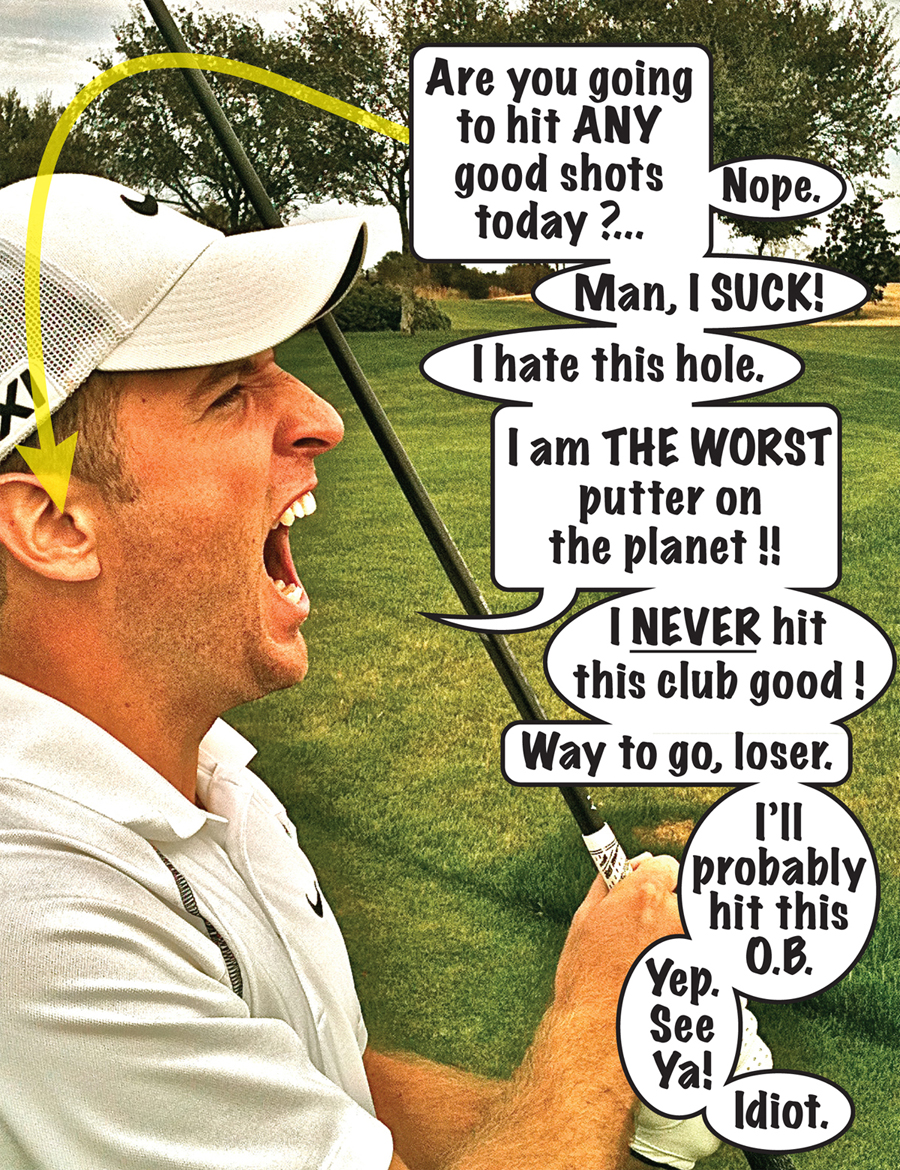
Look at it this way. If you had a caddie who spoke to you the way that you speak to yourself, you’d fire him. Period. But I see so many golfers who beat themselves up constantly. This destructive behavior makes it almost impossible for anything good to happen on the course.

I talk with my team about this subject a great deal. I tell them, “Remember, on the course, you are the only cheerleader you have.” So why is it that most golfers beat themselves up? Why aren’t they pumping themselves up instead?

Most golfers have two categories for golf shots. Either it is acceptable, in which case they remain mostly silent, or it is terrible, which is made obvious to all by negative self-talk. When they hit a bad shot, I would prefer that my golfers accept that they are human and therefore imperfect and prone to mistakes, and just let it go.  My rule is, if you insist in venting for the bad shots you must also say something positive when you hit a good shot. It’s only fair. Good and bad comments must balance themselves out.

On our team we have a rule: VERBALLY recognize every effective shot. By the way, verbal means, out loud. It is not acceptable to just think it. It has to be out loud. In fact, this is so important that over the years, during a few collegiate qualifiers instead of using scores to determine a winner, we have kept track of how many times a player has remembered to say something positive after good shots. That’s how serious I am about this. In time, my players notice that they’re actually doing far more good than bad just because they hear more positive comments than bad. This is a great way to improve a golfer’s self-confidence. And now, on the course we sound and play like winners.

Notice that the rule also says, verbally recognize every EFFECTIVE shot. An effective shot is not necessarily a great shot. Example: Let’s say you have a 7 iron into the green. You hit it thin and it runs most of the way on the ground, but finds the green. That’s an effective shot! It may not have looked pretty, but you met your goal. According to my rule, at this point, you have to say something positive. Why? BECAUSE YOU DID GOOD! Remember, the goal of a golf shot is not for it to look good, or to be technically perfect, it’s for the ball to find it’s target. Period. So don’t stand there in the fairway after a less than perfect shot rehearsing your swing and finding fault when you were just successful. Your shot found it’s target. You achieved your goal for Pete’s sake! Just pat yourself on the back and focus on the next shot; you’ll make a better swing next time.

For years, before focusing on positive self-talk, during a tournament round I would see many of my golfers hanging their heads and beating themselves up. And guess what? The more we assaulted ourselves verbally, the more we stunk it up. It would drive me nuts! Now that we employ the recognize every effective shot rule, my players have the ability to keep themselves in a positive frame of mind, even when things aren’t going their way. And guess what? Their bad play almost always turn around.

It doesn’t matter if you’re a college player, an amateur or a tour pro. If you let yourself get into a negative frame of mind, you might as well walk off the course, because nothing good is going to happen. I believe that whatever comes out of your mouth goes right back into your ear and then into your brain. It has been confirmed by scientists who study the brain that your thoughts actually carve out the grooves in your brain. That’s how a thought becomes a habit and a habit becomes behavior. This explains why most golfers never get better. They have programed themselves to expect the worst. It’s a fact, your brain is a computer and will only do what it’s programmed to do.

The solution is simple. Go ahead and react if you have to when you hit a bad shot. But then, when you do something good, pat yourself on the back. Tell yourself OUT LOUD that you did good. You must refill the emotional tank that negative thoughts and words use up. Learn to re-program your brain. Soon you’ll find yourself playing better golf and people will enjoy playing with you more.

We’ll keep talking about this subject in future lessons.

Thanks for following!
Friggin’ Brain

One of the ironies of golf is that you have to really use your brain, but it can also can kill your game. Learning how and when to use it is the key to good golf. The brain and the body should have a dialogue. However, if your brain is speaking when the body should be swinging, you’re gonna’ play bad golf. After their best rounds, all golfers say the same thing: “I wasn’t thinking about anything. I just let is happen.” Turning off the brain at the right time is crucial.

Standing over the ball at address for more than a few seconds rarely produces good results. If you linger over the ball on any golf shot, all your brain is doing is creating doubt and fear. I know, I know. You’re going through a check-list of all the things that you need to remember before you swing. While running through your mental list of to-do’s may seem like a positive, this practice is actually sabotaging your game.

Concentrating harder does not equate to better results. The opposite is actually true. If you let yourself be an athlete over the ball and turn your brain off during the swing you will have better results. You’ll swing more freely and you’ll have a lot more fun.

Scientists have determined that the brain can only think about one thing at a time. The key is to distract the brain from from thinking about golf while in the address position. In fact, Golfpsych, one of the top mental training programs employed by tour pros, recommends that many of their golfers think about anything other than golf between shots. Sometimes even while over shots.

Vision 54, another golf mental training program, teaches golfers to cross what they call the “commitment line.” You can think about technical things while you are behind the ball, but once you are over the ball you must rely on your athletic skill and intution. If while over the ball you start having technical thoughts you must then step away from the ball, clear your mind and start your pre-shot routine again.

What we need is a little self-hypnosis. When you drive your car to work you don’t think about what you’re doing or how it happens very often because we’ve done it thousands of times. Poof, you magically arrive without much conscious effort. You just let it happen. Your mind was elsewhere. You were on auto-pilot.

I like to have my golfers swing the club as soon as possible after they address the ball, not allowing time for the brain to do bad things. Brandt Snedecker does this. He commits, steps in and hits it. I work with many of my students to  determine the ideal amount of time it takes for them to get comfortable and then swing. On the range, I count out loud to train them on their timing. At first, most of them feel rushed, and you may, too. This makes sense, because almost everyone takes too long over the ball. As a coach I work together with my players to shorten their time.

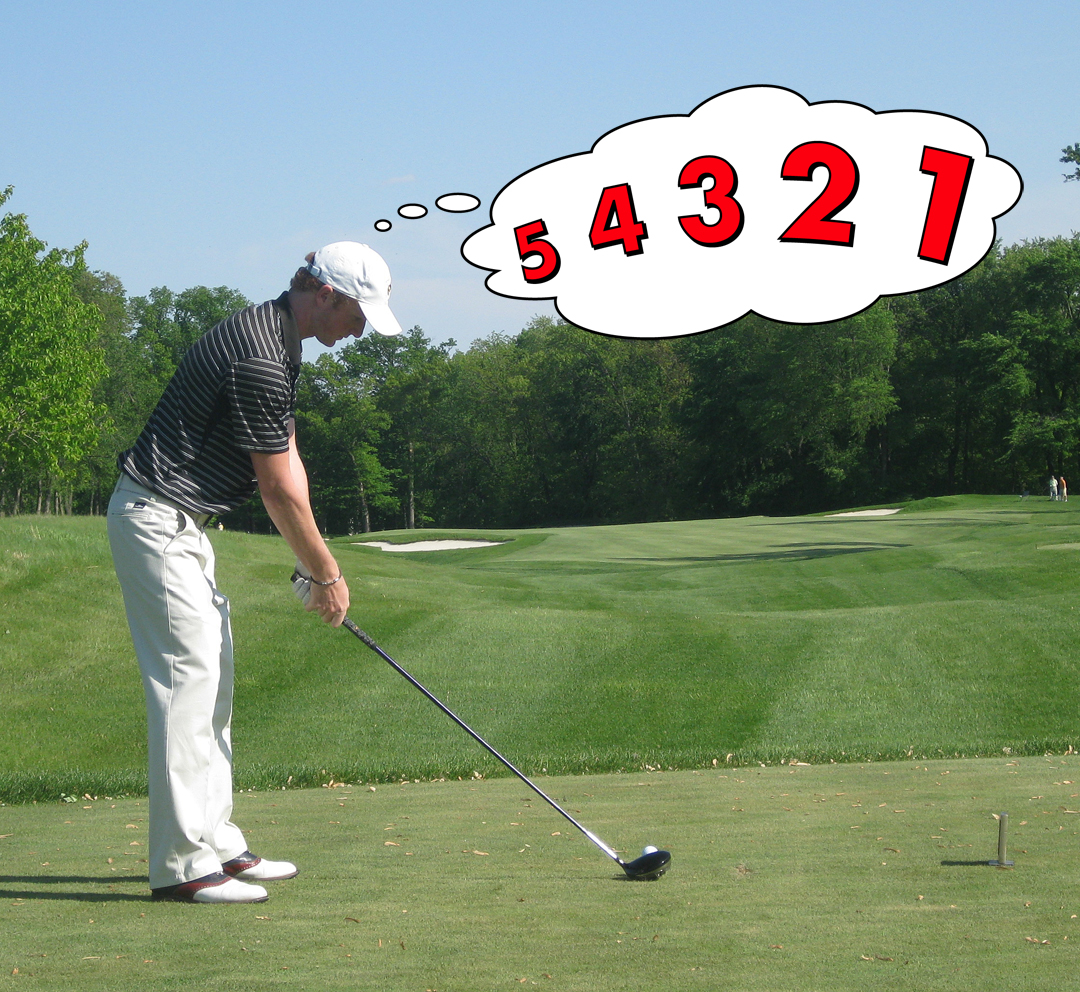
While I count the player will settle into the shot. He sets his feet; sometimes there is a waggle of the club or a tug on the shirt. Each golfer has his own unique way of addressing the ball. I will count slowly, “5… 4… 3… 2… 1.” When I say, “one,” it is time to pull the trigger. Ready or not. Boom! Players are always amazed at how much more frequently they hit the ball great, once they employ the countdown. They quickly realize all of the prep work they used to do was no help at all. If fact, it hurt them! This is a very liberating discovery. Greatness was there all the time, hiding behind that friggtin’ brain.

The countdown is a great pre-shot routine to adopt because if your brain is busy counting, you are not thinking about your swing, or O.B., or hazards, or score. Thinking about that stuff keeps you from playing your best. The countdown helps get you into auto-pilot mode.

Get over the ball. Tell your brain to shut up. And swing! Make sure you yell, “Boom!” while the ball is screaming through the air.

Each month I will be doing another piece about the Friggin’ Brain.

Thanks for following. If you find this helps you please come back I’d love to hear your comments!

Identifying Flying Objects

Unless you gain an understanding of what your ball is doing in the air you can’t take action to correct your problem.

There are only 9 flights that your ball will take after it has been hit. Once you have identified your predominant ball flight making the necessary corrections to your grip and alignment really aren’t that difficult. Hopefully this will help you better understand cause and effect and what adjustments need to be made to improve. Then, it’s a matter of staying committed to what is scientifically correct.

Let’s run briefly through each outcome. We will start in the middle:

Straight: This is the ideal. The club comes into the ball on a great path with the clubface square to the target. Life is good.

Hook: The path is good but the clubface is closed at impact. You just need to weaken your grip.

Slice: The path is good but the clubface is open at impact. You just need to strengthen your grip.

On the left branch of the ball flight tree (Pull) are the ball flights that of course start the ball left. Which means the clubhead came into the ball on an outside to in path.

Pull: If your ball goes straight left with no real curve the clubhead traveled on an outside to in path with a square clubface. You need to work on alignment which will affect the path of your club.

Pull Slice: The clubhead came into the ball with an outside to in path with and open clubface. You can play golf with this ball flight but you’ll really lose distance. But at least the ball works back toward the intended target.

Pull Hook: The clubhead came into the ball with an outside to in path with a closed face. If you hit this shot often keep a lot of balls in your bag, you’re gonna’ need them. Change your grip and alignment.

On the right branch of the ball flight tree (Push) are the ball flights that of course start the ball to the right. Which means the clubhead came into the ball on an inside to out path.

Push: The clubhead came into the ball with a inside to out path with a square clubface. Work on your alignment. You are probably aimed right.

Push Hook: The clubhead came into the ball with an inside to out path with a closed clubface. You can play golf with this ball flight because the ball works back toward center but you’ll probably have a pretty low ball flight and the top spin that this shot creates makes it difficult to control your iron shots because the first bounce on the green will be big. I recommend playing with a ball that gives you a lot of control. You have learned to have a strong grip to compensate for aiming so far right.

Push Slice: The clubhead came into the ball with an inside out path and an open clubface. Just like with the pull-hook if you hit this shot regularly keep a lot of balls in your bag. You need to work on alignment and strengthen your grip.

As you can see from the descriptions of each shot there are patterns. You’ll either want to adjust your grip or your alignment or both. Most of the root problems of the golf swing come back to a faulty grip and/or alignment. If you are willing to do a little investigative work and make some changes you can make a real difference in your game that will last.

In future lessons I will be giving advice on proper grip and alignment. So please keep following.

Thanks for the comments.

The Poop on the Loop

In the last lesson, The Pro Position, we we talked about where the clubhead needs to be when the shaft is parallel to the ground. In this lesson I’ll tell you why.

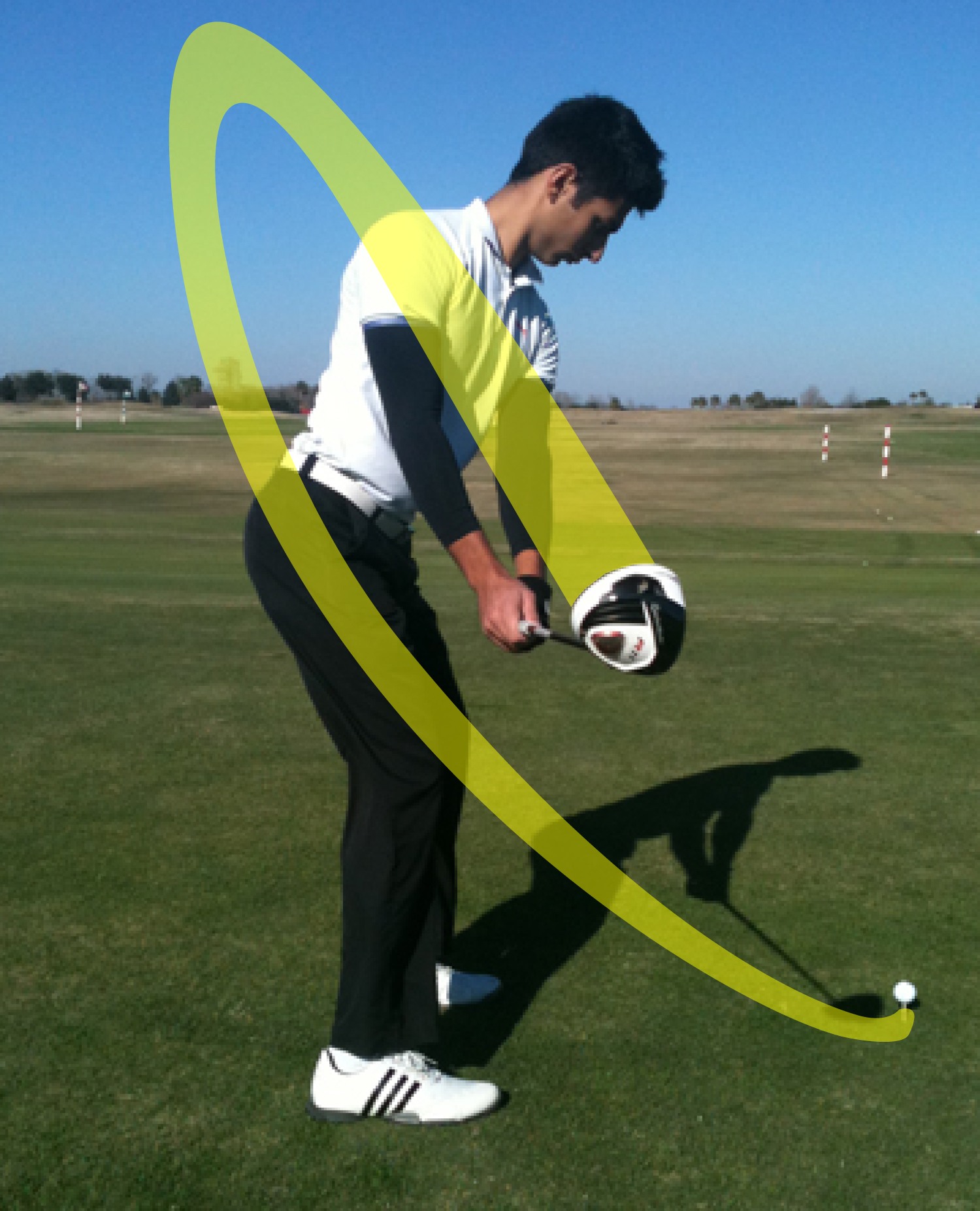
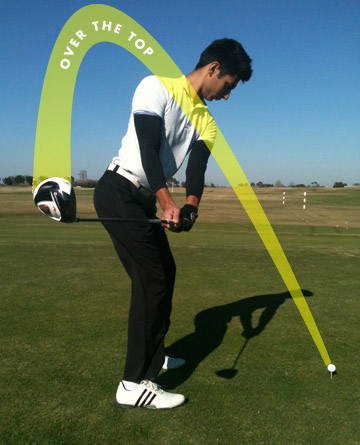
Here’s the poop. Like it or not, during the golf swing the clubhead is going to make a loop. The clubhead doesn’t just swing back and through on the same path. With all of the turning and twisting the body does during the swing this would be almost impossible and not to mention, counterproductive.

So, you have two choices. First, let’s talk about the best option. If you get into The Pro Position you have already done most of the work and the club is on a terrific path that will set the club in a beautiful position at the top of the swing. Then, without any effort on your part the club will come down into the ball on a nice inside path and you’ll hit the ball where you were aiming. By choosing this option you will play more confident golf and then begin to focus more on targets and playing more instinctively, instead of having doubts and fears running around your mind during the swing.

Now, the other option makes golf much harder. If you take the club back inside when the shaft is parallel to the ground your body will begin its process of trying to make compensations for a faulty swing path. Because the clubhead is stuck behind you at this point your arms will begin to lift the club to try and re-route the club. This more than likely will result in the club coming in from the outside or, the classic over the top move. Many golfers have this move but they don’t understand how they do it and more importantly, they don’t know the cure. Well, here it is.

When the club comes over the top it creates so many potential problems that I can’t discuss them all in one lesson. Each person who hits from over the top has their own unique way of screwing up the shot. Sometimes you’ll hit snap hooks. Sometimes you’ll hit pull-slices.Sometimes you’ll hit it straight. The possibilities are endless. And if your brain knows the possibilities are endless its going get overloaded. Now many golfers can play decent golf with an over the top swing but they’ll never play to their potential. Because in crucial moments the compensations the body and mind are trying to make, don’t usually work when you’re in a pressure situation during your round.

This loop keeps golf very unpredictable from day to day and shot to shot.

So that’s the poop on the loop. I say, make this hard game as easy as possible.

Thanks for a awesome first week! The response has been great! Thanks for the comments and as always, if you have an issue you’d like discussed, leave it in the comment box. I’ll get to them.

Awesome Irons

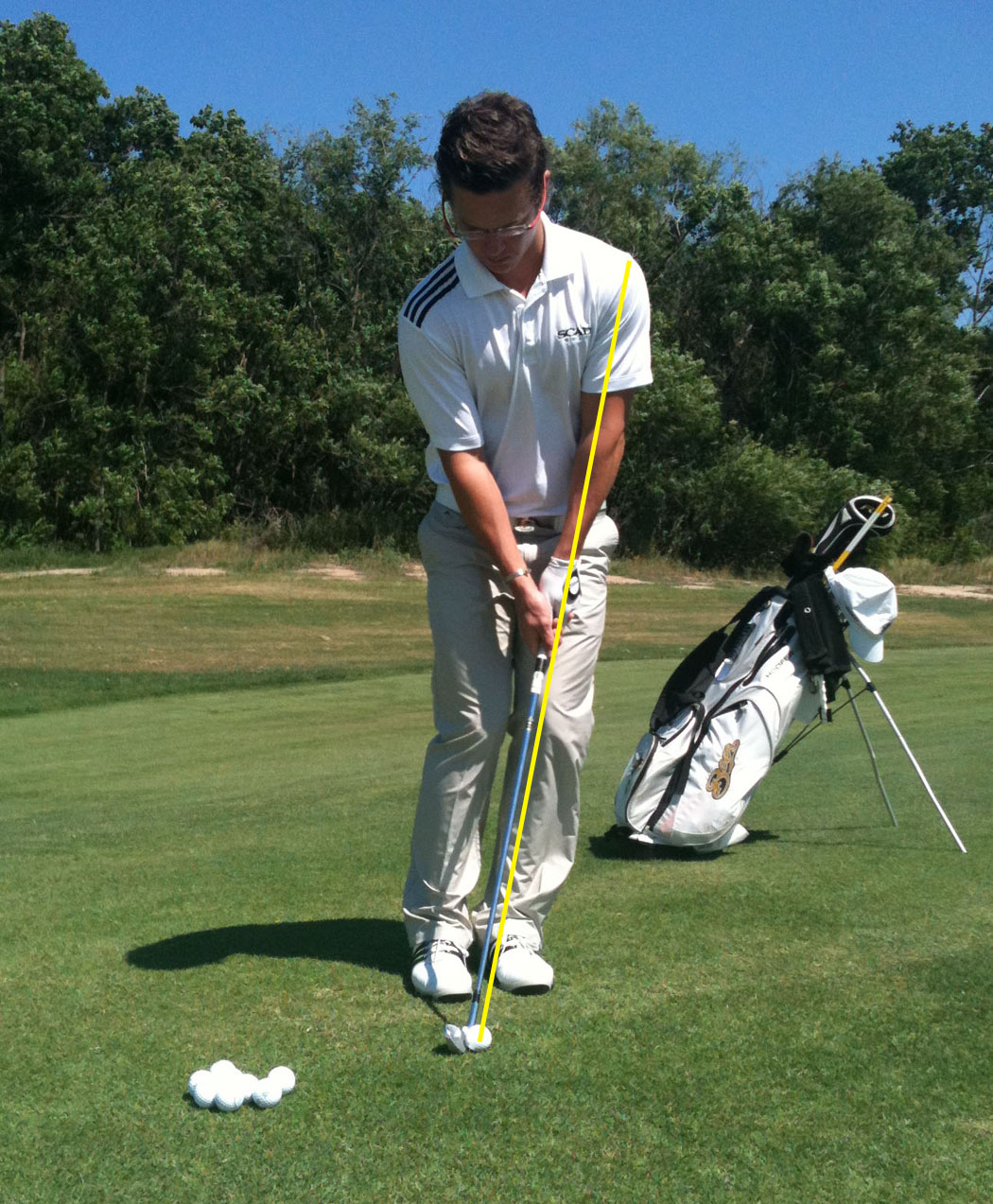
When I am giving lessons to new students more times than not one of the first things I have to adjust is how far or close someone is to the ball. Most golfers don’t have a clear understanding on what is the most effective. I find that most golfers stand too far away from the ball with their irons, with their arms extended and locked in a stiff, un-athletic manner. This is one of the root causes of poor swing mechanics. Extending the arms so far away from the body creates a myriad of problems. “Reaching” creates tension in the arms, flattens the swing plane, which creates a poor swing-path and makes it difficult to make solid, consistent contact with the ball. In addition to that, being too far away from the ball reduces swing speed so you won’t hit the ball as far.

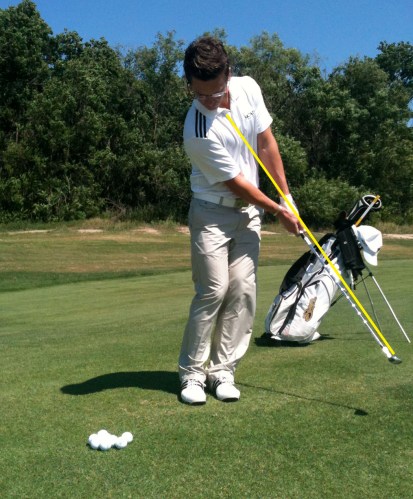
Hopefully, this photograph will explain and make it easy for you to understand how to get into a proper set-up position.

I really only look for one thing. I want to see the toes, the butt end of the grip and the shoulder on the same vertical line. If those 3 things are touching that line you’ll be in great shape! Let your arms hang straight down. Don’t reach! If you set up like this you’ll find a lot of your swing problems will be diminished. Many of you will feel at first that you are too close to the ball, but you are not. If you feel that way it’s because you were too far away from the ball to begin with.

Try this an your swing will feel fluid and athletic. Your path will be better. Your contact will be better. The ball will fly long and straight!

If you have a topic you’d like discussed please use the comment box. I will be glad to address your questions. Thanks for reading!

Putting with Loft

It seems the Bump-and-Run shot has been forgotten for the most part but my golfers find it easy to learn and wildly effective in tournament play. I had Hall-of-Fame college coach Ed Cottrell teach it to me my first year coaching. I always wished I had known about it when I was a college golfer. I considered myself to be very good around the greens but if I had had this shot in my arsenal I would have been amazing! B&R addressHe called it, “putting with loft.” It’s so easy and effective that all of my golfers see their up-and-in percentage go way up almost instantly after learning it. They think it’s magic. Once you learn how to play the bump and run and learn your distances with each club, you’ll be amazed at how many more shots you make from off the green and how much more often you leave yourself a tap-in. The beauty of this shot is that you learn one shot and use it for multiple clubs. I require all of my golfers to learn how to play this shot with everything from their lob wedge down to their 6 iron.

Note: the Bump-and-Run is intended to be played when you are 2-6 paces off the putting surface with nothing between you and the green.

Here’s how you do it:

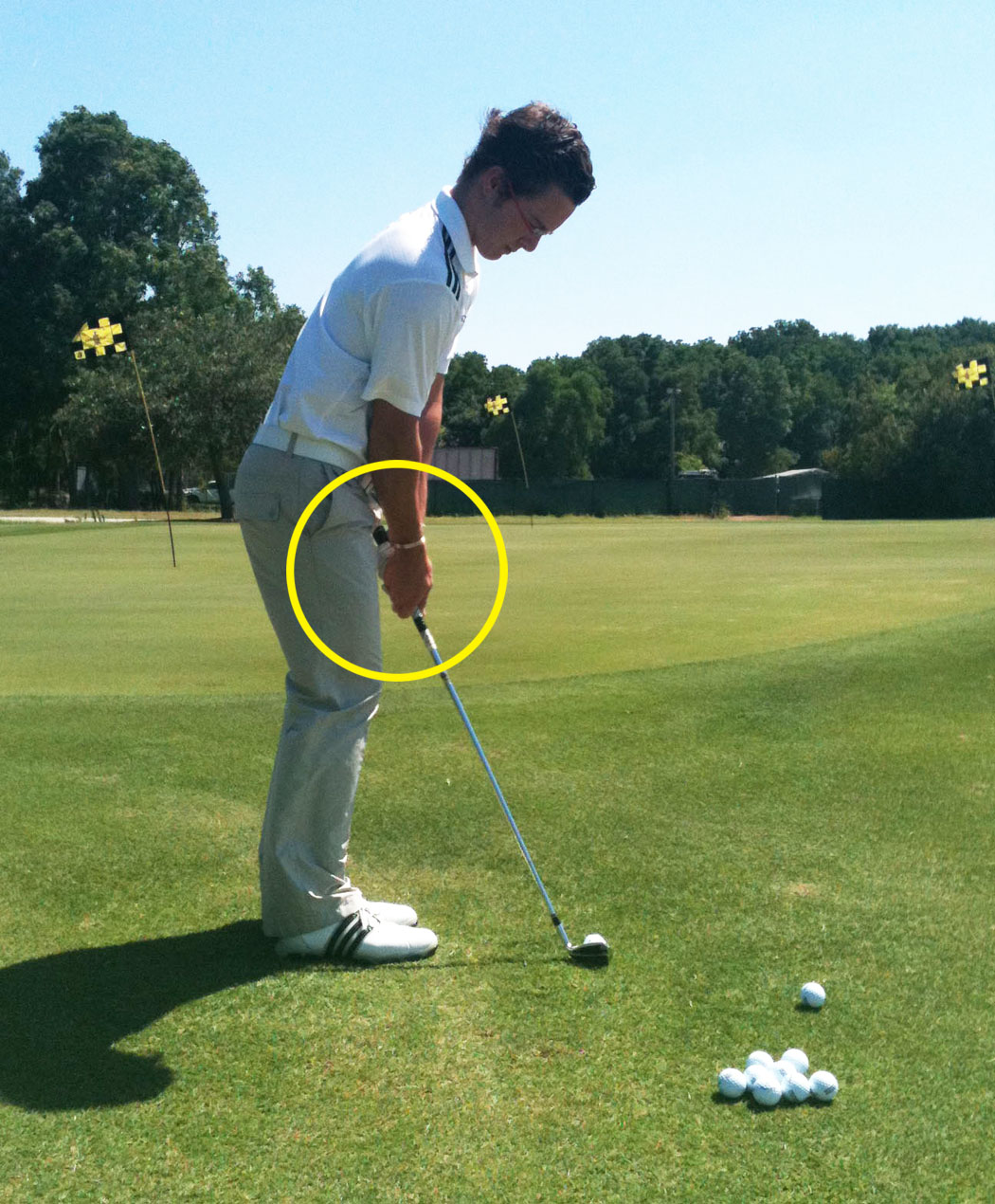
B&R set up down lineSet-Up:

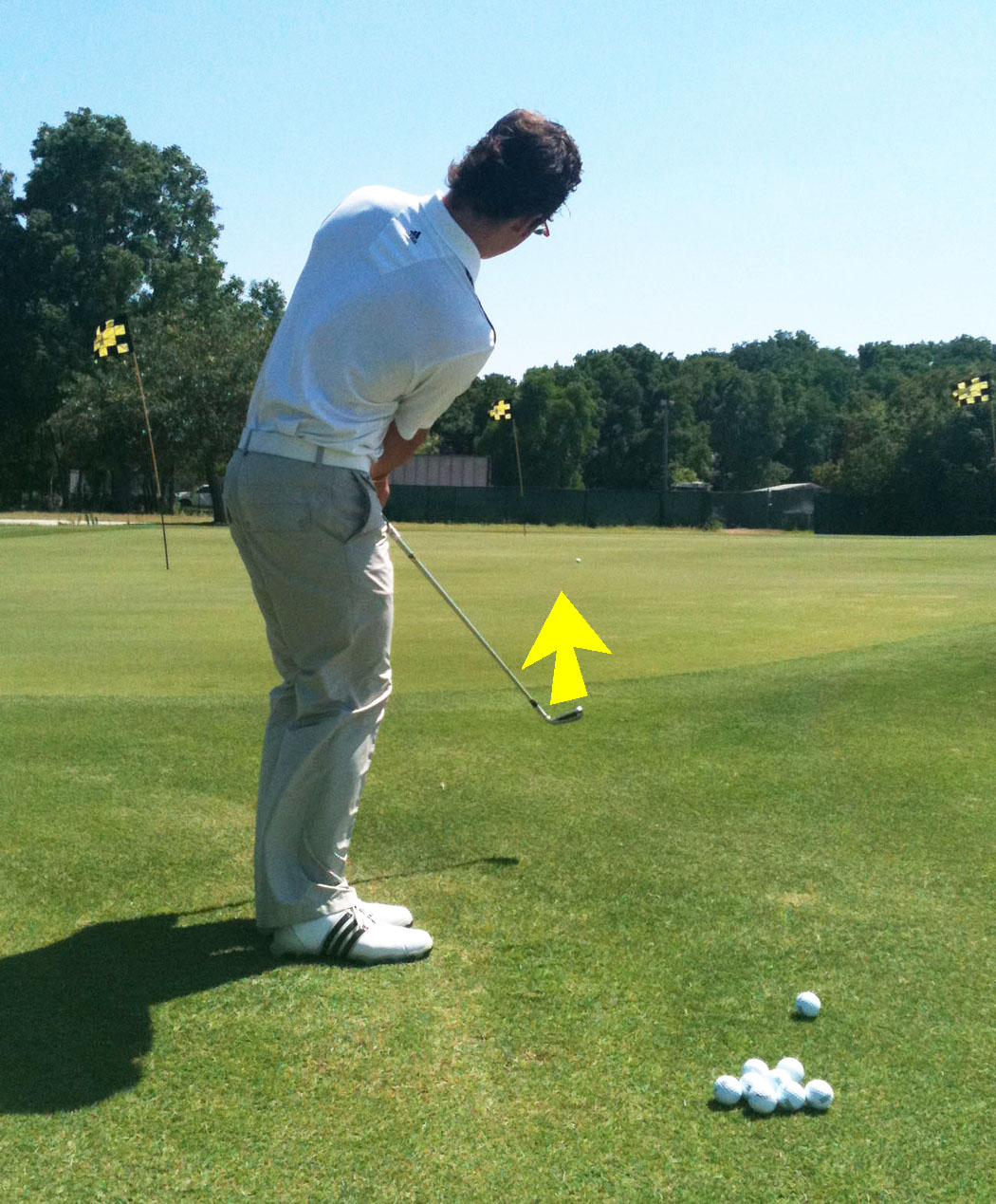
Feet are very close together if not touching. Ball is placed off of back foot, weight is mostly on the front foot. Sternum is ahead of the ball. This will position the hands ahead of the ball and give forward lean in the shaft. Notice how the lead wrist is perfectly flat and there is a straight line extending all the way from the shoulder to the clubhead. Also notice how close he stands to the ball – his hands just about touching his thigh.

B&R back

Backswing:

With little to no wrist-hinge take the club back. The lower body should remain quiet. The hands should go no farther than the back edge of your leg. The distance of your backswing will determine how far the ball will go. You need to be consistent with this position to get consistent results. It will feel like a very short stroke at first but after a little practice you should have no problem finishing your backswing here.

B&R through copy

Follow-through:

B&R through down lineFinish with the clubhead low. Notice the wrist remains straight. The butt-end of the club is in alignment with the sternum indicating that the there is no “flipping”of the clubhead. Another sign that you have not “flipped” the clubhead through the shot is by checking the position of the clubhead. The face should be “looking” right at the target.

If you have questions about this shot please leave your comments and I will be glad to respond.

Are you a Chump or a Champ ?

Here’s a situation that I have seen a million times over the years that can save or ruin a round.

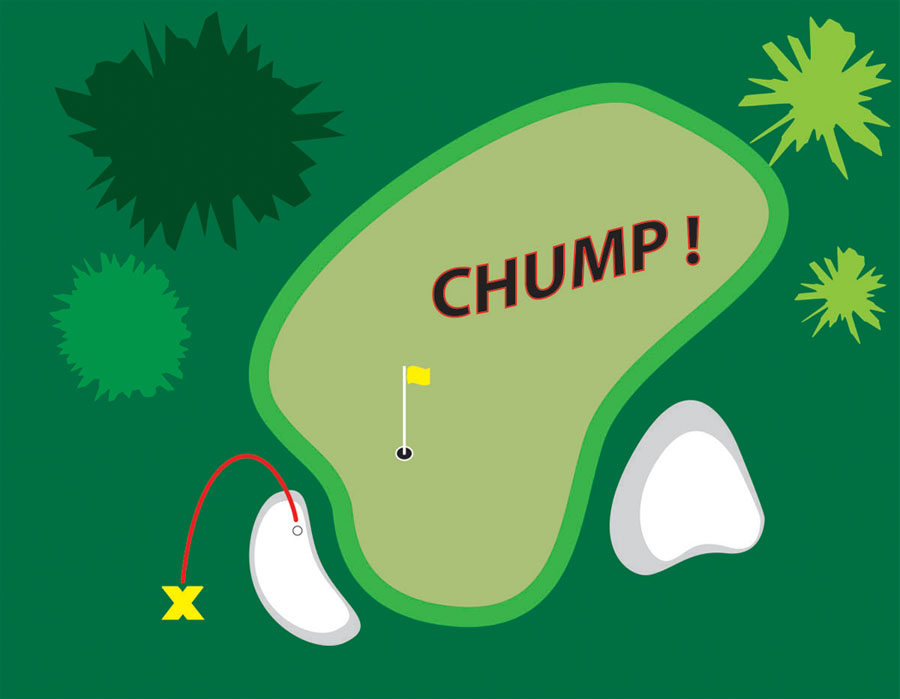
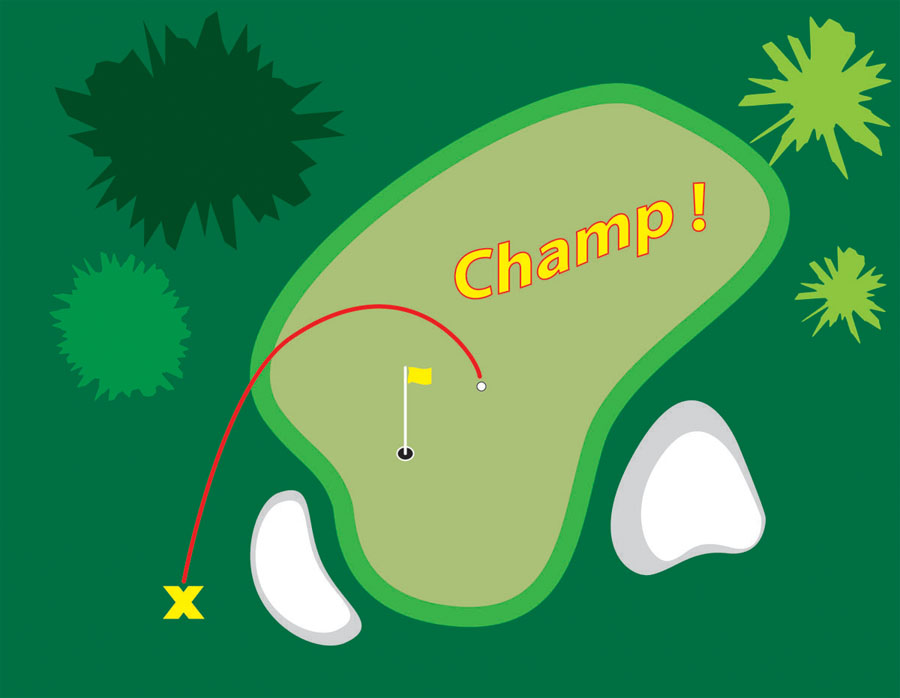
A player has short–sided himself as shown by the yellow X in the lower left. The pin is tucked on the left side of the green with just a few paces from the left edge of the green. In this situation a golfer needs to decide, am I going to be a Chump or a Champ?

I have found most amateur golfers fall into the trap that they need to fit the ball in the very small area between the edge of the green and the hole. He wants to like the Pros. The player then of course tries to get too cute or doesn’t commit to the shot or swing hard enough or the club gets caught up in the rough. He more or less duffs it and ends up hitting again from the same situation or even worse. He’s what I call a CHUMP and his day is about to take an ugly turn.


The second attempt ends up where the first should have, and instead of making a bogie at worst, he ends up with a double or higher. Which most times leads to another mistake being made on one of the very next holes. The round is beginning to unravel.

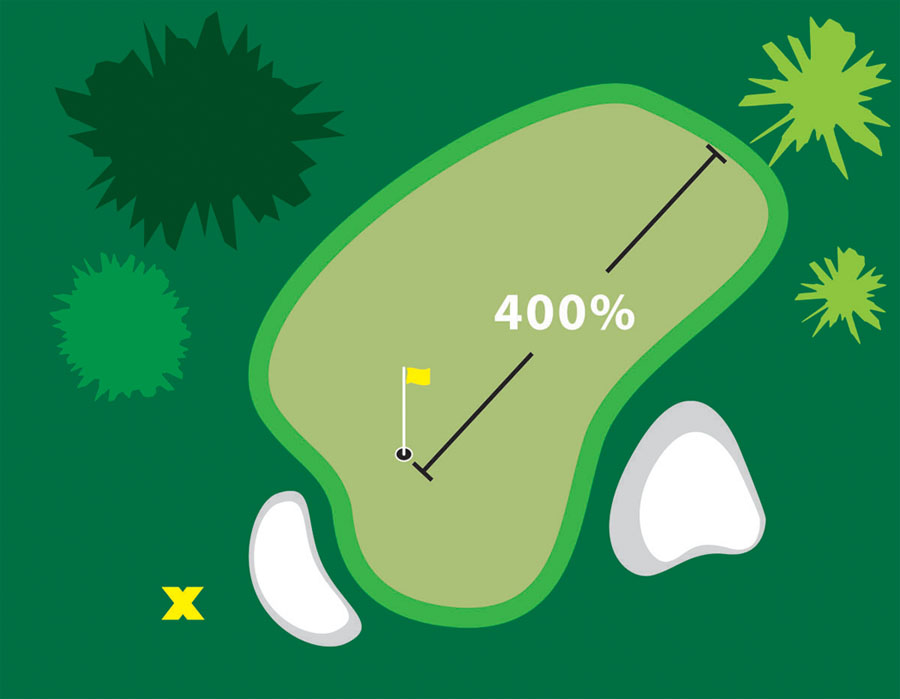
When you are short sided, there is almost always a mile of green on the other side of the pin! Hence the term, “short-sided.” The only way you can look or feel stupid is by coming up short of the green. Yet most do. I don’t get it! You’d have about a 400% better chance of success if you go past the pin. And you’ll take the big mistake, and number, out of the equation.

The more experienced players on my team always make the smart play. They make sure that the shot gets past the pin. They understand that this is not a time to play aggressively and to take their medicine and if they do lose a shot they’ll have a chance later in the round to make up for it. Over the long run they know it will save them a ton of strokes.

One of the benefits of getting the ball past the pin is that if you miss-hit the shot or decelerate through it, that the shot will still end up on the green.

I always like to think that Johnny Miller is doing play-by-play on me when I’m in those situations. If I hit it past the pin he’d say on air, “that’s really all he had.” If I left it short, Johnny would lay into me saying something like, “Wow, that was really dumb. What was he thinking? Now he’s left with nothing and probably lost the tournament.”

I never want Johnny Miller laying into me.

Recent Entries »