Category Archives: golf instruction

The Littlest Shots Make the Biggest Difference

If you’re like most golfers, you spend most of your practice time on the range, and finish up with a few quick minutes on the practice green. I believe everyone should reverse that and spend the majority on your practice or warm up time on the practice greens and less time beating balls. If you look around your club you’ll notice that the best players hang out around the practice greens a lot. If you want to be one of the best players at your club I would suggest you do the same.

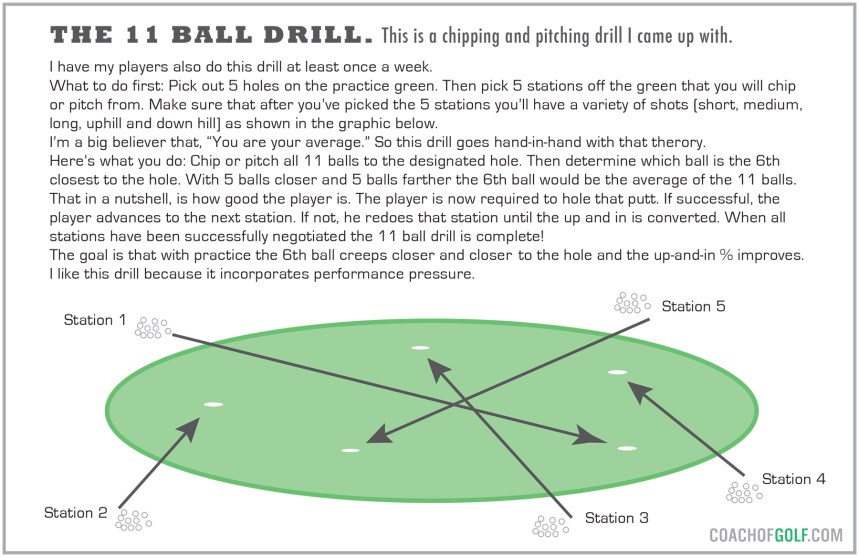
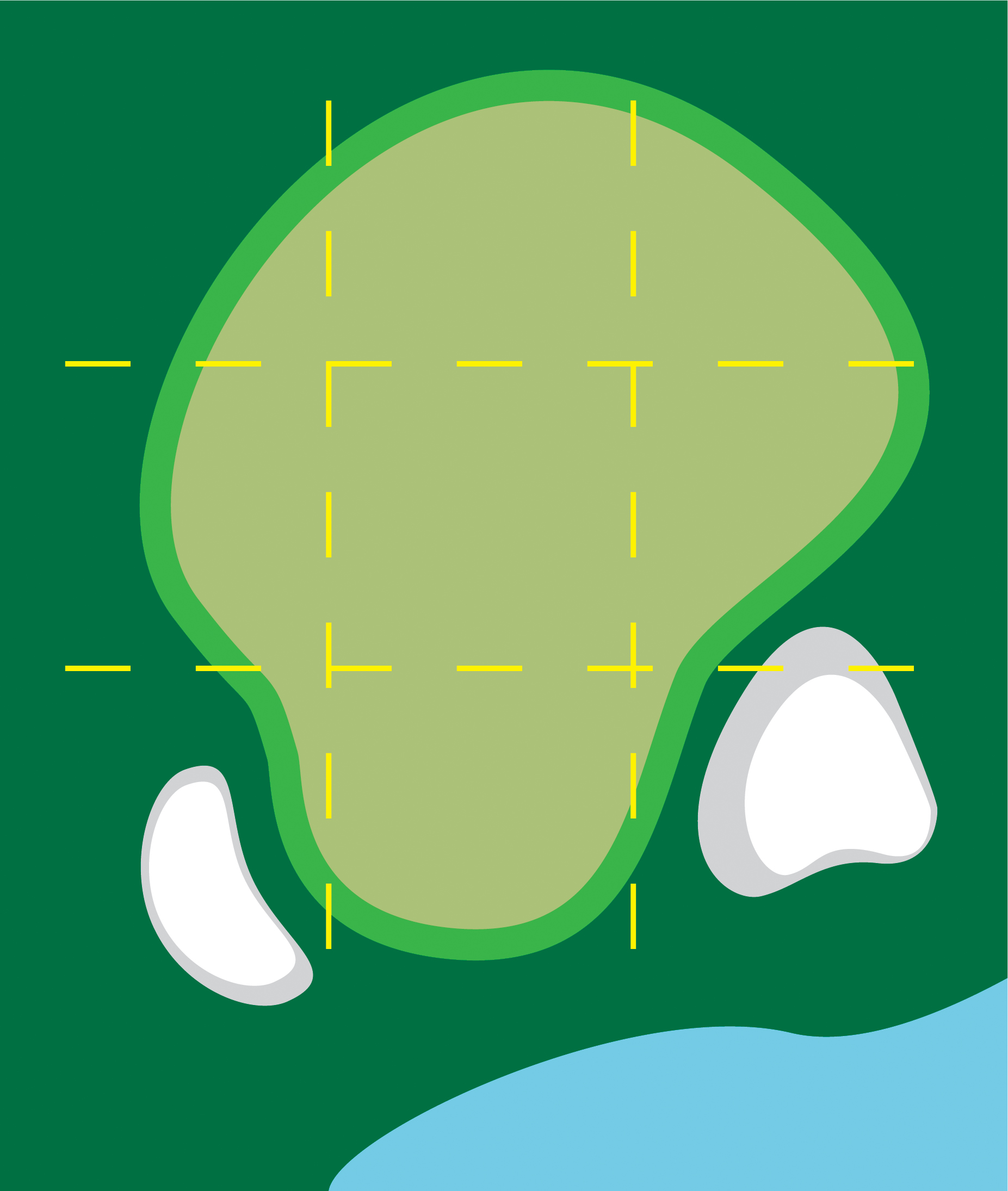
COG 11 Ball Drill

At least half of your shots during a round come from on or around the green. Most of the time it’s the quality of the Little Shots that determine the quality of your score. You could improve half of your game simply and quickly by improving your skills around the green—without going through swing changes or investing money in lessons or equipment!

Many years ago, my wife and I spent our honeymoon in Scotland, the birthplace of golf. We drove from town to town seeing the sites and enjoying the Scottish culture. Almost every evening, almost everywhere we went, we noticed townspeople of all ages practicing putting and chipping.

COG 11 Ball Drill

Practicing your short game is a great after-dinner activity. I find it very relaxing. Late afternoon and evening is the most beautiful time of day, and there usually aren’t many people around to distract you so you can get in some quality practice.

It beats sitting on the couch, or trying to squeeze in a quick nine and being frustrated by poor play. Try investing time instead of spending time.

Here are two great drills that will help your short game. You only need a dozen balls and if you spend an hour or two a week doing these drills you’ll see real results.

I know these drills will help you score better and enjoy your rounds more.

Chipping Chopsticks

I see golfers struggle with the short game (chipping and pitching) more than any other part of the game.

I call the short game The Big Eraser. Reliable chipping and pitching will erase mistakes that are made with approach shots. It’s a fact that you’re going to miss greens. Even pros miss five to six greens per round—so that means the average golfer will miss even more! It’s frustrating when you can hit the ball 400 yards in 2 shots, yet it takes 4 more shots to get it in the hole from 30 yards. If you want to lower your handicap you have to have a solid short game. Chipping and pitching are crucial for scoring.

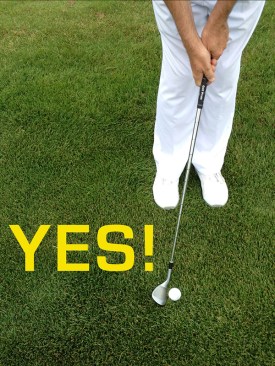
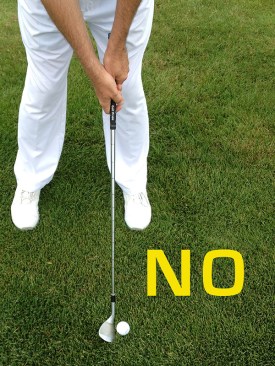
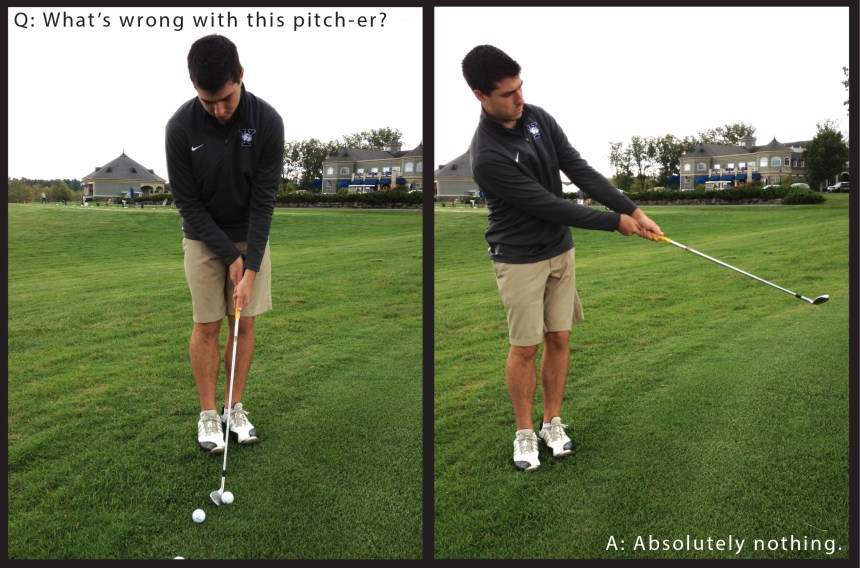
There are two common mistakes I see most golfers make that sabotage their short shots. One is ball position. Many golfers’ ball is way too far forward in their stance. This is setting up for failure. If this is your ball position, you regularly hit shots around the green fat or thin. That is why your confidence is low. So from now on, put the ball in the middle or even a little back of center in your stance because you want to hit the ball while the club is moving downward. Just like in the photo. You’ll get instant results.

photo 2sm photo 1sm

The second mistake I see is a stance that is too wide. Watch the pros. Usually on pitches and chips their stance is very narrow, unless they have a crazy lie. The pros take a narrow stance to eliminate any lateral movement. Shots around the green are finesse shots and shifting weight on this shot is counterproductive. I can tell you all of the technical reasons why this works but instead of boring you, just set up like in the photo and be amazed how instantly your chips and pitches improve. Also, notice the shaft leaning forward in the YES photo. That is essential for hitting quality shots.

And remember one more thing: with chipping and pitching, everything is opposite.  DOWN = UP. If you want the ball to go up, hit down. Don’t scoop or try to lift the ball in the air. If you do try to lift the ball into the air, you will often mishit it.I tell the golfers I teach to try to hit the part of the ball that you can’t see.

Chipping Chopsticks Drill

I came up with the Chipping Chopsticks drill to help my students improve their chipping. And yes, you will need chopsticks. (You can get them at the grocery store. Just go to the area where they sell sushi. They’ll be lying around there and they’re free!)

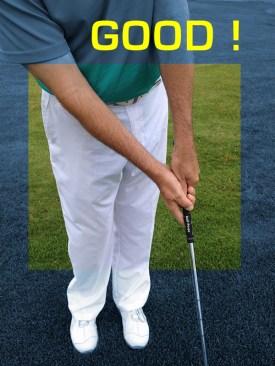
photo 3sm

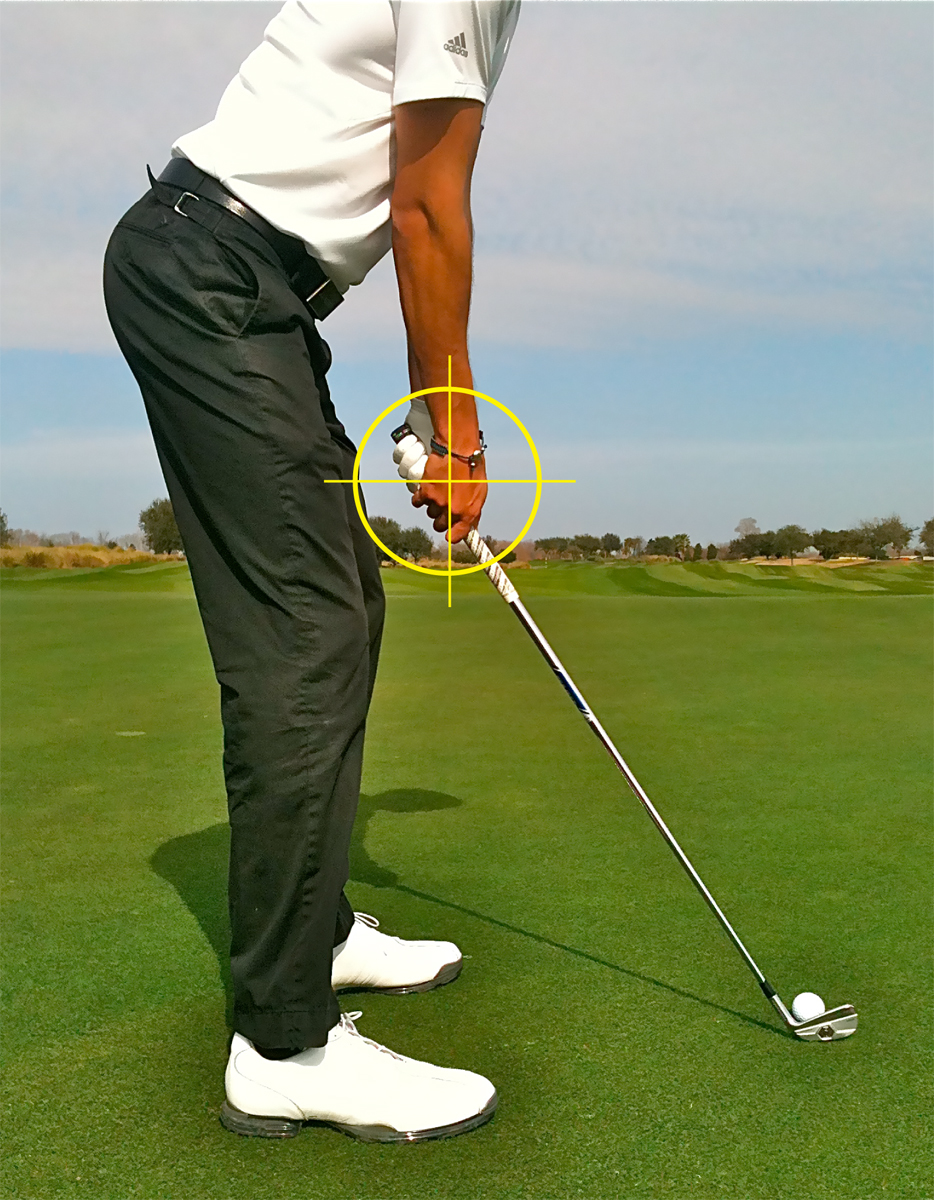
photo 4smStick a chopstick in the end of your grip. When addressing the ball for a chip, if you are set up properly you won’t see the chopstick, because it will be in line with and covered up by your forearm (see photo). When you do this drill, at no point should you be able to see the chopstick. This shows that you kept your left wrist firm. If you can see the chopstick you’ll know you let the left wrist break down (scooping) and the chopstick will be visible and now pointing at your back shoulder. That is BAD.

So now you know why you hit poor chip shots. With very little practice you will be hitting beautiful crisp chip shots and saving strokes.

A Golfer’s Biggest Hazard, Part 2

In a previous post (A Golfers Biggest Hazard, Dec. 2012) I wrote, When you prepare for a round of golf, you should make a mental commitment — a commitment to accept whatever happens, good or bad, and in the words of Winston Churchill, “Stay calm and carry on.” 

golfers biggest hazardGolf is a tough game. If you want to enjoy it you need to be equally tough. Golf can and eventually will beat you up mentally. Every golfer goes through tough times. As I have said to every golfer I have coached over the years, “you must embrace the struggle.”  The crazy thing about the game we love is that we can hit hundreds of shots perfectly, but if we hit one poorly at the wrong time it can make us doubt everything we do. A golfer’s memory seems to be very long when it comes to remembering the negative, and very short when remembering the positive. I’ve seen it more times than I can count: One of my players is going along great and all of the sudden he hits a poor drive or misses a short putt and for the remainder of the round, and perhaps for weeks after, doubts his ability. Now he is totally distracted from the task at hand – playing golf. As he wonders what happened and why, he hits more poor shots, and as his score goes up his confidence goes down. And so the spiral downward begins.

I prefer to take a more philosophical approach. I believe golf is a living, breathing thing. It can sense fear and weakness, and when it does, it will devour you. The only way to prevail against the beast is to remain upbeat and optimistic and as you do, the beast will go away and then golf will reward you.

I believe, when you struggle, golf is actually trying to teach you something. Golf has a great way of exposing your weaknesses. For instance, if you struggle with chipping you will find yourself missing greens and having to chip. If you practiced chipping more it wouldn’t be such an issue, but it is human nature to avoid practicing what you’re not good at. Instead of avoiding the weakness you should practice to overcome the weakness. So, in essence, golf is giving you exactly what you need – opportunities to chip! Golf always exposes you.

In the December 2012 post I told the tale of Makenzie Denver, a young man on my team who learned the importance of not giving up mentally when things got tough on the golf course. If you haven’t already I encourage you to go back and read the story. It’s a good one that can help all golfers.

CoachandDenver crop1Denver, my most talented player, struggled during his freshman year with staying mentally engaged when he had tough rounds. When things got tough he would mope and sulk believing he was a victim and the only one golf was picking on. This cost him strokes. Afterward, when looking at the leader board, he realized that if he would have stayed mentally tough during the round and hung in there and fought hard, three things would have happened: 1) he could have helped our team more; 2) individually, he would have finished high in some important events; and 3) he would have gone away from the tournament with no regrets. As Ghandi said, “Full effort is full victory.”

This past March we were playing at the Jekyll Island Intercollegiate on the coast of Georgia over spring break. It’s a very important event. In fact, it’s the largest tournament in NCAA golf.

In the first two rounds Denver played okay, +1 in the first round and +6 in the 2nd. Not bad considering the winter we had in the Northeast and the fact it was the first time we had seen grass in four months.

In the final round Denver got off to a solid start, parring the first two. The 3rd hole is probably the easiest par 4 on the course — just a 3-wood or hybrid off the tee, and a short pitch of about 60-80 yards to the green. Denver hit some poor shots, and ended up with double-bogie on the hole. On the very next hole, a tight par 4 dogleg right, he followed up the double with an eight. Yep, a snowman.

During all of this I was on another part of the course with one of my other players but knew what was happening because the tournament had live scoring and I was watching the gruesome events unfold on an app on my phone. Denver was now 6 over par after four holes—not the start he in anyway imagined. I didn’t rush to go see him right away because I knew he’d be okay. We had been working on turning his weakness into his strength for a more than a year now and I knew he had the tools to stay “up” mentally and accept the adversity and move forward.

I caught up to him on the par 3, eighth hole. The first thing he said to me with a smile on his face was, “Did you hear what happened?”

I told him, “Yeah, I heard.”

We laughed about it and said to each other, “Lets get some strokes back.”

Denver was in a great frame of mind and I stayed with him for most of the remainder of the round. His attitude remained terrific and he fought like a champion. After his disaster on the 3rd and 4th, he fought his way around and played the rest of his round 2 under par to finish at +4 for the day—really respectable. In fact, he came back to tie one of his playing competitors and beat the other.

Denver 1 crop

Golf isn’t always about winning. Many days it’s about salvaging. Golf always teaches you something, especially on the hard days, but you have to be willing to endure pain in order to get the reward. Denver had already learned the lesson and because he didn’t panic, mope or sulk, golf rewarded him. He didn’t have to win or shoot the lowest score to demonstrate his greatness. A lesser player would have quit mentally and shot a high score. Not him. He earned the respect of the young men who played with him; not only that, they learned a lesson from him — how a champion responds when things get tough.

I was an extremely proud coach that day.

It’s Always Darkest Before the Light.

Recently a player on my team experienced a major breakthrough. It’s a great story that could help many golfers, so I thought I’d share.

I have a player on my team named Brett. When I arrived at Skidmore College last year and assessed the players’ talent, I found Brett to be good from tee to green. He was a solid putter, but in two areas rated very poor:

1. Brett’s golf self-esteem was non-existent. He always believed the worst would happen on the golf course, and it usually did. Rarely did I see him get any amount of joy out of playing golf. Golf was a chore. He reminded me of Eeyore from Winnie the Pooh.

2. Brett’s short game, in a word, stunk. And that’s saying it nicely. He was dreadful when it came to pitching and chipping.

Whats wrong with this pitcher?So, we got to work. We spent a great deal of time over weeks and months working on mechanics and attitude, and we saw some progress. But even though he put in a lot of work, his confidence remained fragile. He had a deep seeded fear of chunking shots and thinning shots over the green, and if it ever actually happened, his confidence crumbled like a house of cards. We’d have to start all over again with fundamentals, drills and repairing confidence. This was the pattern all of last year and into the beginning of this fall season.

We had our first tournament a few weeks ago. Playing on the “B” team, Brett was playing well in the first round. I saw him at the turn and he told me he had hit every fairway and green; however, on the back nine, he began missing greens. His score went up quickly, and he shot a disappointing score. The next day was worse. The previous round eroded any hope of success. Needless to say, his score was really bad.

The next day at practice, Brett showed up with a “solution”: a left-handed wedge. Brett plays golf right-handed. It was clear he was a desperate man. He told me he was sick of going through this, and he was willing to try anything. I told him I respected him thinking outside the box, but I didn’t think that this was a viable solution. I suggested something that we had tried for about fifteen minutes last spring. He hadn’t been in a place mentally at that point to try something new, but now his mind was open. Here was the opportunity.

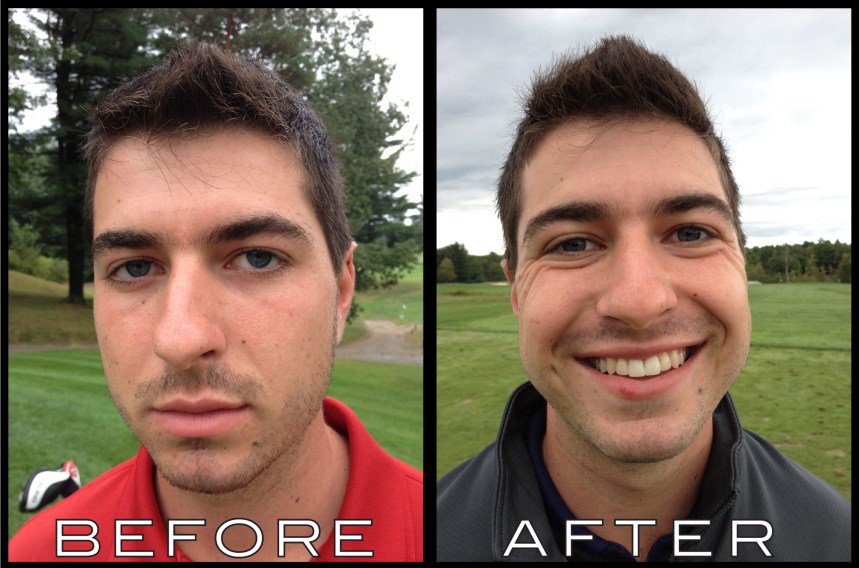
He tried it willingly. And within an hour his whole life seemingly changed. Within twenty-four hours, he was like an entirely different human being. I think that day was the first time I had ever seen Brett’s teeth at the golf course. Brett is quick with a smile off the course, but on the course you’d think his cat just died. I didn’t recognize this guy! He was having fun! There was hope! He called it, “a miracle!”

I watched him practice with amazement. Pitch shot after pitch shot floated beautifully through the air, landed softly on the green and cozied up close to the hole. Each shot was struck beautifully and effortlessly. Brett’s body language was completely different. He was relaxed and fluid–not the tense ball of doom that I had witnessed for over a year.

Over the course of the next week he challenged teammate after teammate to chipping and pitching contests (in the past he would have never done that), and won!

Before:afterOk, so what was the cure? Look at the photo closely. Did you catch it? I had Brett go left-hand low on his chips and pitches.

Why does this work? Because many times a right-handed player will carry all of his or her stress in the right hand. When that happens, the right hand squeezes the grips and stabs at the ball when under pressure and the left wrist breaks down. Reversing the hands neutralizes the right hand and allows the left hand to pull the club through the shot. Since the left side is the weak side for righties, you’ll be more prone to swing the club with the body, because you won’t be able to squeeze as much with the right hand.

I don’t recommend this for everyone. But hey, we exhausted all other options. In golf, there is no one right way to do things. The ultimate goal is be effective. I approach coaching the same way. Each player is a riddle and every riddle has a solution.

The other moral to the story is this: Desperation isn’t necessarily a bad thing. Until Brett was desperate, he wasn’t brave enough to embrace something new. When someone isn’t willing to try another approach, one thing is for sure – improvement is impossible.

I really respect Brett for his bravery. It’s nice to see him happy, confident and excited to play. This could turn his entire college career around.

If You Don’t Want to Choke, EAT MORE !

I believe nutrition is the single most important factor that most golfers fail to consider when preparing for competition. The topic isn’t talked about much, and if something isn’t talked about, it’s not a priority. Well it should be, so let’s talk about it.

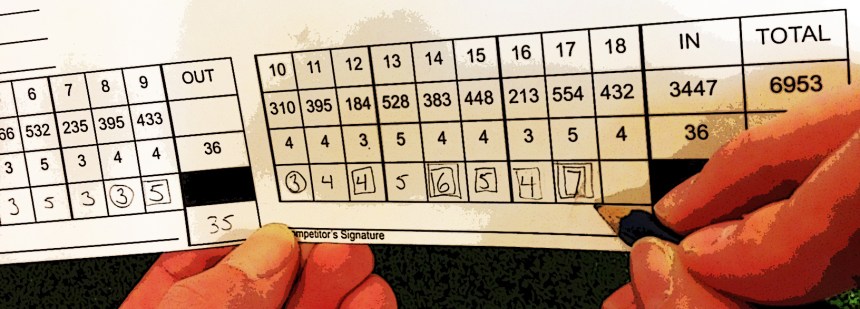
When I recruit a young man I spend a long time talking to him about all aspects of his game. We talk about putting, driving, iron play, etc. We also talk about how he plays, what he thinks about while playing, what usually happens when he plays well and what goes wrong when he plays poorly. When he plays poorly many times he explains the situation like this:  The round starts out very well, then about the 14th hole everything begins to unravel. The young man doesn’t really know why, he just knows that he chokes at the end of rounds—usually in tournaments.

scorecard1The first thing I ask is, “How much do you eat out there?”  The answer I usually get is either, “Nothing”, or “I had a pack of crackers during the round.” I hope to God that I don’t hear, “I had a hot dog at the turn.” That one drives me nuts.

I then ask, Do you know how many calories your body burns during a round of golf when you walk?

At this point I get either silence or a shrug. They usually have no idea.

Well, for all of you out there, the answer is right around 2000! That’s almost a days worth of calories!  I know, right? Surprised?

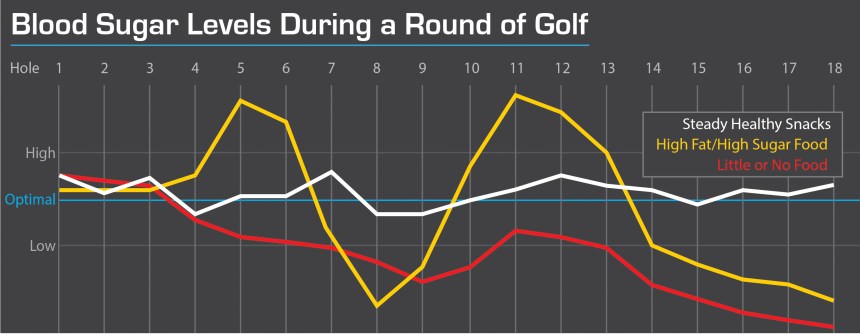
The reason he finished poorly is pretty obvious to me. He simply ran out of fuel.

Almost every golfer that I’ve ever coached prior to their experience with me operated at what I call a Calorie Deficit. I have discovered that teaching a player to eat may be just as important as teaching them the swing.

PrintYoung people are calorie burning machines. I know very few moms who have sons that don’t eat constantly and in great quantities. Yet these same young men go to the course to play or compete and do so with no food in their bag and by the time they have hit balls and played, they will have gone six hours without eating, maybe more. I ask them, “Aside from sleeping do you ever go 6 hours without eating?” Of course not. Yet while doing an athletic activity they starve themselves of the fuel they need to compete at a high level! This makes no sense.

Let’s say you were going on a trip in a car. One of the first things you would ask yourself is, “Do I have enough fuel to get me where I want to go?” The same question needs to be asked prior to a round of golf or even more importantly, a round of tournament golf.

One of the biggest reasons golfers “choke” stems from a lack of food in their belly. Simple as that.

When you lack fuel it not only affects your energy level (blood sugar) but it also affects your ability to make sound decisions. The brain needs fuel just as much as the body in order to operate at an effective level.

Don’t misunderstand what I am saying—don’t go and pound down 2000 calories prior to your round. That would be equally disastrous!

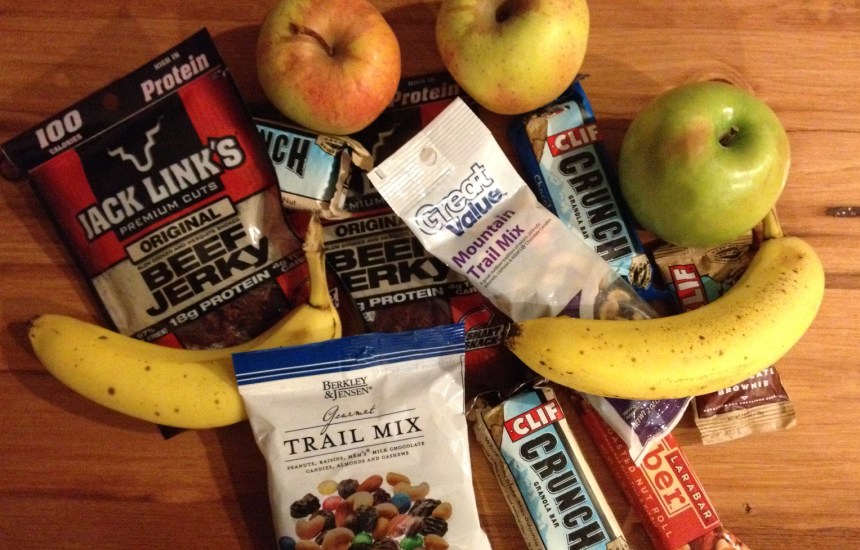
foodMy golfers always eat a ton of healthy snacks while on the course. This always comes as a shock to my freshman. Most aren’t used to eating at all. As I tell them, “you’re not eating because you are hungry, you are eating to maintain your optimum performance level. If you wait until you are hungry to eat, it’s too late. Chances are we’ve already lost strokes out there.”

When we compete we eat something every 2 to 3 holes, but never garbage! (hot dogs, hamburgers, candy bars, chips, sodas, etc.) Those items are loaded with fat and will cause your blood sugar to spike and then dive. Eat things that will help you perform like the athlete you are! You want to maintain a consistent blood sugar level. My team eats apples, bananas, nuts (excellent) beef jerky, any dried fruit like raisins, trail mix, and a good energy bar like a Cliff Bar or something.

A few years ago I had a golfer from England named Tom. We discovered he played his best when he ate 6 apples a round. I called him Apple Tom. He would eat an apple every 3 holes. He won a lot of college events and became an All-America.

During your round you will need to consume 2000 calories to match what your body will burn.

This is one of the most important lessons my golfers learn from me their first year. When they go home for the summer and play in their local events, state amateurs or national events I usually get a call after the tournament and hear stories about their successes not failures.

I like happy endings.

Happy 80th Dad!

A Golfer’s Biggest Hazard

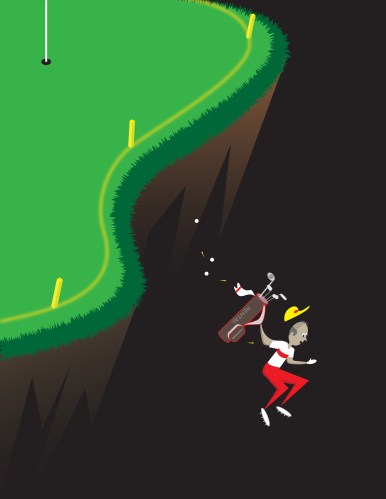
golfers biggest hazardThe biggest hazard that a golfer will face during their round is the temptation to mentally quit during a round of golf. For some reason, golfers go into a round of golf not expecting adversity. This is flawed thinking because it is inevitable. Because they are not mentally prepared, they are shocked and saddened when adversity arrives and too many times they are unable to cope. Like in the illustration, they willingly jump off into the abyss of despair, where there is no recovery and the penalty lasts for the remainder of the round.

Somehow golfers believe that every shot will be hit perfectly and that golf will be easy. That is not reality, not for any golfer at any level. Golfers must remember that golf is usually a struggle. Golf is the equivalent of salmon swimming upstream. It’s hard. It’s hard almost every day.

When you prepare for a round of golf, you should make a mental commitment — a commitment to accept whatever happens, good or bad, and in the words of Winston Churchill, “Stay calm and carry on.”

Staying calm and carrying on no matter what is the only good option you have. Some days are easy, most are hard. You must remain positive and fight with everything you have until you arrive at the clubhouse. Otherwise, you’ll be miserable, you’ll make your playing partners miserable and you will be guaranteed you will shoot a miserable score.

I know all of you have watched Tiger’s top 10 shots on the Golf Channel. Did you notice that none of those shots was from an ideal position? Only one of shot happened from the middle of the fairway, and he hit that shot in almost total darkness.

The point is, one of the reasons he’s been so successful is that he believes with every fiber of his being that something good will happen even when he is in a tough spot.

I have a great example from my university team in 2012. One of the freshman on my team was named Makenzie. He was a fine player and I believed he could become a superstar, but as with most freshman, he had a lot to learn — especially when it came to keeping his head in the game during tough rounds.

We were playing in a prestigious tournament. The Golfweek Fall Preview in Florida. This is an account of Makenzie’s final round.

He had high expectations, too high. When I saw him on the range, Makenzie was upbeat, “minting it” as he says, and was telling me he was going to tear it up.

So, I caught up with him on the 7th hole, a par 5. I thought he has just played his 2nd from the fairway, but I then learned that it was actually his 4th shot. His 2nd shot had gone out of bounds. He was completely despondent because after finishing his 7th hole with a double, I learned he was now seven over after seven holes. The round was not going at all the way he had envisioned. I could tell he had mentally checked out and he had no fight in him. If I had given him the option he would have walked off the course. I told him, “Sorry dude, I don’t get to substitute like in other sports. You’re stuck out here and have to make a decision to make. Are you gonna cry or try?” It’s something I used to say to my young son. He would always take on projects that were beyond his abilities and eventually get frustrated to the point of tears. I would say to him, “Son, we can cry or try, we can’t do both. We’ll do which ever one you want. But you have a decision to make.” Back to Makenzie… he was mentally checked out and we still had 11 holes to play in the final round of a really important tournament. I wasn’t going to let him let his team down or himself down. I told him, “We can still salvage this round! So, lets get started right now!”

makenzie action wedge

On the par 3, 8th tee he hit last so we had time to chat. I got his mind away from his troubles and told him how much I thought of him as a person and as a golfer. I reminded him how beautiful this part of Florida was and how blessed he was to be able to play college golf.He hit a nice approach. As we walked to the green we laughed as I told him stories of other golfers I coached through the years and the times when they were able to make something out of nothing. When we got to the green we were surprised to see he was left with a really difficult 36 footer that was down hill and a double breaker. We read the putt from every angle and what do you know, we made it for birdie! Big smile on his face! He was back!

On the most difficult hole on the course, the par 4 ninth, he played the hole well but ended up 3 putting from long range for bogie. Just like that, his world was coming to an end once again. I said, “What is so bad? You’ve just played the last 2 holes at even par after a terrible start on the first 7 holes! So I continued to make him smile, telling him funny stories about coaching and golf as we played the par 4, 10th hole and what do you know, we made a really good 18 footer that broke from left to right for another birdie!

Once again, big smiles, life was good. Unfortunately, he bogeyed the par 5, 11th and was once again in the dumps. Total despair. Life sucks! He thought, golf hates me! After more cheerleading from me, he made a routine par on the par 3, twelfth. I pointed out to him that in spite of the ups and downs that he had just played the last 5 holes at even par and that he’s doing fine. But now I had to leave him to go check on other members of the team. I had him promise me that he would remain optimistic and upbeat. He assured me he would be fine.

I caught up with Makenzie again as he was walking from the 13th green to the 14th tee. His life was over! He had just triple bogeyed! All of the fight was completely gone. There was nothing left. He was now 10 over par.

At this point, I’ll admit, I had had enough! I “coached him up,” as we say in the biz, albeit firmly. I told him he had a decision to make — this time, it wasn’t as much about this round, but more about what kind of player he was going to be. I challenged him, “You’ve got to decide right now, is golf tougher than you, or are you tougher than golf?”

I had his attention. Once again, I told him that if he had total 100% belief that something good was going to come out of this, it would, and conversely, if he didn’t, it wouldn’t. Whatever he decided would happen, would actually happen. He was now completely on board. We then took a moment to map out the final stretch of 5 holes. I thought we could birdie 3 of the last 5. He completely bought in, had total belief in his skills and Makenzie went on to birdie 14, 15 and 16! He had completely erased the triple! Now he completely refused to let his mind have a single negative thought. We were on the 17th, probably the best chance for birdie and after a monster drive, ended up making a tough par after pretty much chopping up the hole.

He played the par 4, 18th perfectly and made a 10 footer for birdie to finish out his roller coaster round. We hugged and laughed. He had birdied 4 of his last 5 holes and 6 of his last 11. Makenzie played the last 11 holes at -1.  He shot +6 for the round and ended up helping our team.

Ironically, not once did we talk about swing during his round.

It wasn’t the most impressive round ever shot — a 77. But for him it was the springboard that propelled him to be a great collegiate golfer. As we stood there watching the others in his group putt out, I’ll never forget he had his arm over my shoulder thanking me for my help and telling me how much he had learned.

His collegiate playing career is now over. I can assure you, that’s one of the few rounds he remembers. That’s how it is in college golf. You play a lot of rounds in a lot of places. You don’t remember much about the good days. There isn’t much to remember. Those days are easy. The proudest and most memorable rounds are the ones where you dig deep when faced with adversity and come out on the other side learning something about yourself. The ones where you made something out of nothing.

If you never give in and jump off into the pit of despair, you too will have great stories to tell.

Pictures Can Lie, Your Hands Won’t.

As a college coach and teaching professional I receive many swing videos from young men wanting me to recruit them. Most think that just having someone standing somewhere behind them videotaping their swing is enough for a coach or a professional to determine what is right and what is wrong with their swing. This couldn’t be farther from the truth.

In fact, last night one of my new golfers sent me a video. It was of very nice quality but because of the angle at which the video was shot, I couldn’t make an educated determination about what was really happening in his swing. I saw his swing but didn’t really SEE his swing, if you know what I mean.

With the introduction of video smartphone APS and the like, everyone is using video to record their golf swing. Now more and more golfers have the ability to see and learn more about their own swing. This is great! It’s a powerful and useful tool and it’s fun! I love it! I use it almost everyday.

Here’s what you’ve got to know though:

When you use video as a training tool, camera position is vital if you really want to improve your golf swing. If the camera is positioned incorrectly you will get misinformation and you could end up trying to fix something that isn’t really a problem, or you might not ever see the root cause of your real swing issues.

I’m going to show you how to set up your video so you get the most accurate information about what is really going on during your swing.

It’s really easy. It’s all in the hands.

When videotaping in the “Face On” angle, always have the camera at the height your hands are at the address position, and right in line with your hands.

When videoing your swing in the “Down the Line” angle, as shown in the photo, first make sure the camera is pointing exactly where you want the ball to go. This should be in a line parallel to where your feet are aligned. Again, make sure the camera is at hand height. Now draw a line straight back from where the hands hang. Use alignment rods if you need, and keep the camera on that line. This will ensure when you look at the video you are gathering accurate information.

If the camera is misaligned in the “Down the Line” position and the camera is outside the hands, it will appear that the person swinging is taking the club way inside during the takeaway. If the camera is positioned too far inside the hands, it will appear the opposite — that the golfer is taking to club way outside on the takeaway. If this is the case when you draw your lines for swing plane, etc. everything will be way off, guaranteed.

With the camera in the right position you will see the true path the club is taking and what you are doing during the swing. Now we can make real improvements.

Wind + Machismo = High Scores

As a coach I observe a lot of golf. I observe much more than I play. As I study golfers, I notice tendencies in individuals, teams, demographics, whatever. After years of observation coaches develop a sort of sixth sense. I now have the ability to see into the future. I can see the mistakes that golfers are going make before they happen. As a result, watching golf can be a very sad and predictable affair for me. In this lesson I am going to speak of one of the most frustrating miscalculations that I see. It involves playing in windy conditions.

Here’s the scenario:

Lets say Joe Golfer shows up at the course to play, and today it’s gonna’ be windy — a constant 20 mile per hour wind. He gets to the first tee and the hole is playing straight downwind. Joe hits a much longer drive than usual, because the wind is pumping at his back. Because of the wind he then hits 2 clubs less than normal into the green on his approach shot. The next hole comes back in the opposite direction, with the wind straight into his face. He hits his drive solidly but ends up noticeably shorter than normal. He can feel the force of the wind on his face but on the approach shot he only takes 1 extra club into the wind. Of course his approach comes well short of the green and he is standing in the fairway with his hat off scratching his head wondering how in the world, because he is so manly, the shot could have come up so short. I’ve seen it a million times. This is one of the main reasons I see scores balloon on windy days.

Pop Quiz: If 20 mph tailwind = 20 more yards of distance then when does 20 mph of headwind = 10 yards less distance?

a) always

b) after 3 Red Bulls

c) never

I’ll wait while you think about it………..

The correct answer is c) never.

The force of the wind is EQUAL whether it’s in your face or at your back.

I don’t know if it’s ego or disbelief or what, but most golfers can’t find it in themselves to take enough club into the wind, and it costs them a ton of strokes. Here’s why:

Think of the course architecture of your home golf course. Green complexes are usually designed to have most of the trouble (bunkering and ponds) just short of the green or in the first third of the green.

Constantly coming up short puts tremendous pressure on your chipping, pitching and putting. The last thing you want to do on a windy day is put extra pressure on your putting. If you are always putting from 6-10 feet for par or bogie when the wind is blowing you’ll quickly find yourself losing strokes, energy and the ability to stay focused.

So, here’s the lesson: If you are hitting 2 clubs less downwind, you’ll also need to hit 2 clubs more when you are hitting into the wind.

There is no shame in pulling more club. No one has to know. Anyway, who cares? All that matters is score. Also, I’m sure you have heard that hitting less club into a headwind and swinging hard creates more spin and causes the ball to rise, or balloon in the air. Well, it’s true.

One thing I can tell you is this: rarely do I ever see anyone go over a green when hitting into the wind. And like I said, look at your home course’s architecture. Most of the time, missing long provides you a much easier chip or pitch than you’d have if you miss short.

Macho Man Tip: Missing long always appears more macho than constantly coming up short.

Creepers! Ugh!

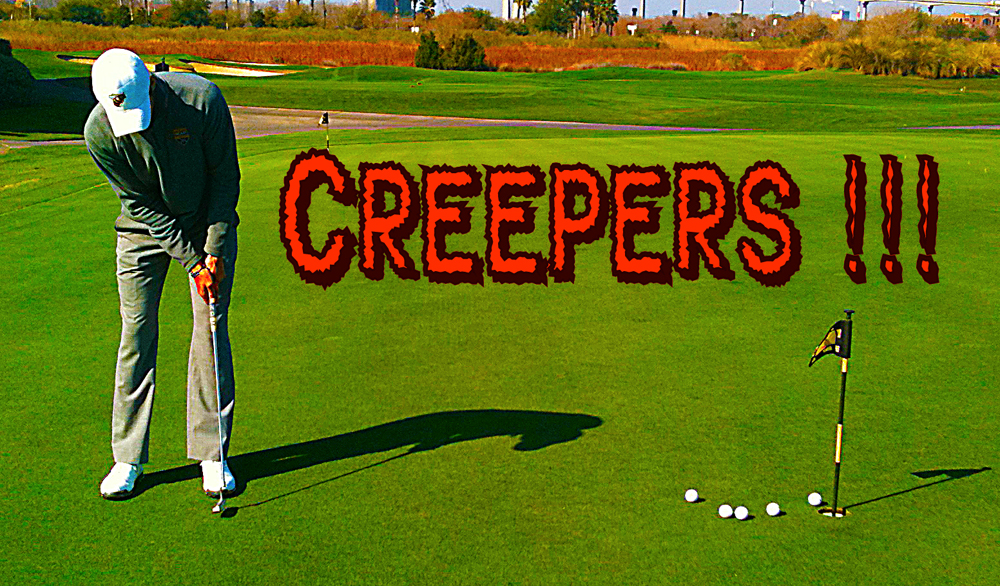
As a coach, one thing I can’t stand is seeing shots come up short. But it is the norm for most golfers on most shots—irons, pitches, chips and putts. It drives me batty! In this lesson we’ll deal with the putts that come up short. I call them Creepers.

How many times have you played a round where hole after hole you hit putts that were right in the jaws but came up just short? I see it all the time. You had a chance to shoot your best score and you couldn’t get the ball to the hole! Frustrating, isn’t it? I know why it happens and I know how to fix it.

Next time you go to the course, watch the people warming up on the practice green. Most have either three balls or a single ball, and each person is putting to a specific hole. As each golfer putts, the ball rolls up short of the hole by about a foot or so. The golfer rolls putt after putt and the same thing happens. If a ball does drop it goes in by a dimple. If that doesn’t describe the scenario on your practice green, I’ll eat a bug.

I believe that the first 20 swings of the day with any club are the most important. Each time you warm up you are teaching your body what you want it to do each day. So, by coming up short time after time on the practice green, you are programming your eyes, brain and hands to come up short on the course. That’s why, when you come up short on putts hole after hole during a round, it seems no matter how hard you try, you keep coming up short.

Creepers! Ugh! I hate them! CREEPERS!!!

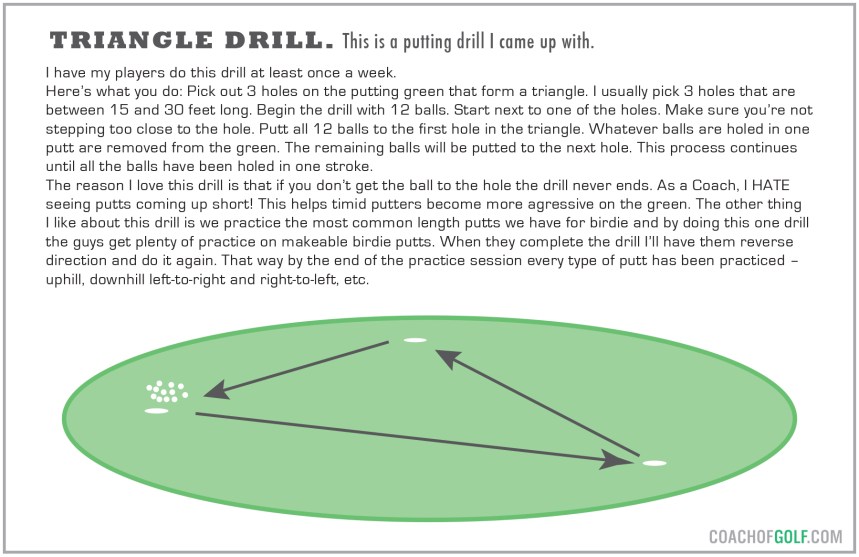
What I have my players do when they first get on the practice green is hit the first 10 putts or so well past the hole, by 3 to 5 feet. It may look silly, but it serves a great purpose. This practice drill will help you hole more putts for many reasons:

1. Your eyes see the ball getting to and going past the hole. You have to teach your eyes that this is a good thing. It’ll then tell the brain and hands that it’s o.k. It’s what you want to happen.

2. It helps ensure a nice long follow-through. If you tend to come up short, many times its because you stop your follow-through a little short. Mostly this happens because of fear of hitting a putt too hard. It’s interesting, isn’t it? A golfer can hit 9 putts out of ten short. Yet he fears the one that went long instead of the nine that came up short. Weird. Especially since the one that went by the hole was the only one that had a chance to go in!

3. You’ll make some of them! You’ll hear that awesome sound of the ball hitting the bottom of the cup. Even if your playing partners aren’t watching, they’ll hear it, too.

I believe that once your body gets used to hitting the ball past the hole, it is easy to throttle back a little. Then your pace on the green will be perfect all day. Conversely, it’s very tough once you’ve taught your self to come up short to make the adjustment to judge pace consistently. But one thing’s for sure: if you teach your ball to come up short during your warm-up, it’s gonna’ come up short all day long.

The lesson is this: “No Creepers!” My team hears me say this every day on the practice green. “Don’t teach yourself to come up short!”

Hit the first few putts of the day on the practice green well by past the hole. You’ll make more putts on the course.

The Golfer’s Achilles Heel

This is probably the first golf lesson you’ve ever had about your heel. You don’t hear many Pros talking about it. So lets talk about it.

When I am working with my golfers, the heel of the back foot is something I am always watching. I believe the heel’s finish position has a huge impact on where the ball is going to end up. I bet a week hasn’t gone by in all my years of coaching that I haven’t at least mentioned something about a players back heel.

For me, at the end of the swing, where the heel is pointing is the clearest and easiest indicator of whether a player has transferred his weight properly on the through-swing. Most amateur golfers finish their swing with their heel in a very poor position. I find this is especially true for older golfers.

“Who cares?” you say. “It can’t be that important!” Well… I do, and it is.

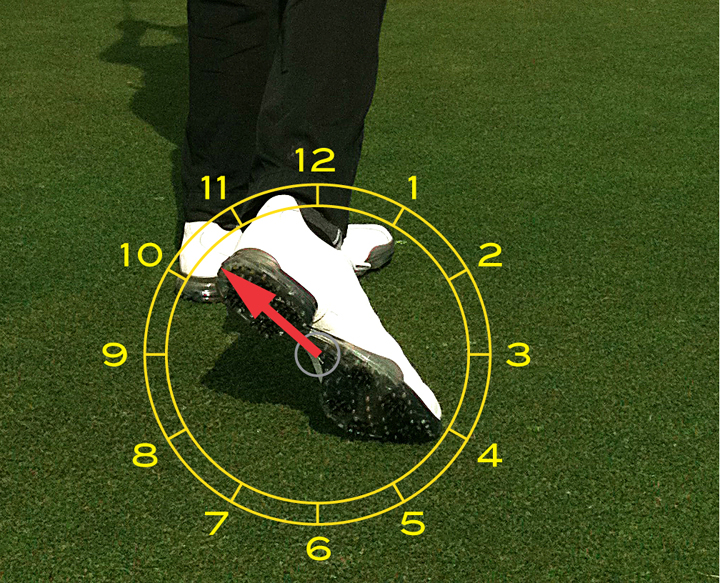
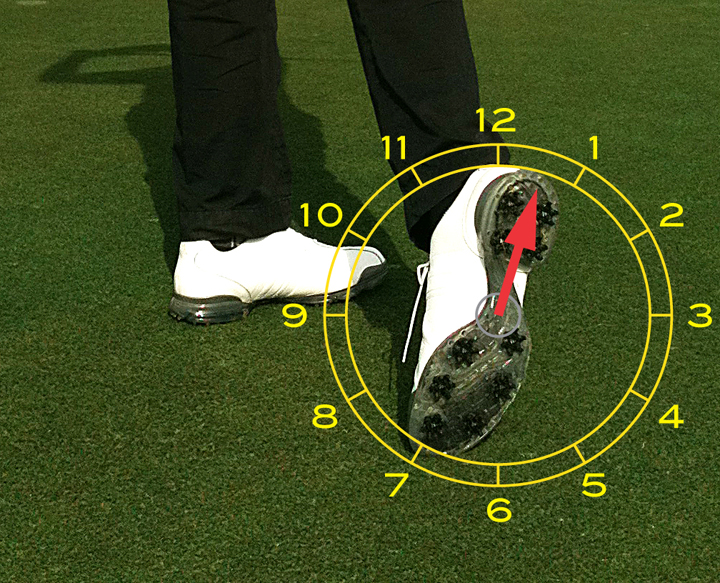
Let’s imagine a clock and the heel of the back foot is the hour hand. In this case we’ll use a right-handed golfer. If his heel finishes in a position earlier than 12 o’clock (shown in first photo) not only has his weight failed to transfer properly on the through-swing, but his hips never fully released, either. In addition, it is doubtful that he will ever be able to Cross the Finish Line. (Last lesson.)

Failure to get the weight off of the back foot causes the lower body to slow down.  To compensate for the lack of power from the legs, the arms take over, and then the hands get too involved. The result is usually an early release, which will produce thin shots, fat shots, a pull or a hook, a push, a slice, etc. Good luck with that.
This looks less than athletic; in fact, if you don’t get off back foot completely, you’ll look like you’re swinging a sledgehammer. When the heel doesn’t finish at 12 o’clock it’s very difficult to predict with any consistency where the ball is going. Especially when it really matters. I’m betting, not at the intended target. By the way, if this is you, you’re the guy I want to play for money.

If the heel ends up pointing at 12 o’clock or, preferably even later (shown in 2nd photo), the player has fully released his hips and will have a nice long balanced finish position; i.e., athletic. He Crosses the Finish Line. More than likely, the ball will end up in a great position. The by-product of getting the heel past 12 o’clock is that the clubhead releases at the proper time not only increasing accuracy but also swing speed.

Another huge benefit is physical. Failing to get your heel to 12 o’clock puts a great deal of stress, on your lower back. If your lower body slows down while the upper body continues to turn through at a high speed, this creates tremendous torque, which could cause serious back injury. Sorry Dad, this is one of the big reasons you’ve had back problems over the years. I’ve even had some of my college guys who look like perfect physical specimens struggle with lower back issues for this very reason. I once tried to swing with my back heel finishing close to the ground while continuing to turn my upper body through the shot fully and I thought I was going to break in half. Wow, was it painful! AND I hit an awful shot. Getting your weight completely off the back foot will eliminate much of the stress the golf swing puts on the lower back.

If for no other reason, get your heel past 12 o’clock to protect your back. You’ll save a ton on chiropractic visits and you’ll thank me for lower scores, too.

« Older Entries Recent Entries »